



Mud in the wheel arch holds road salt against the sill
Tonight the ground freezes for the first time, and the gritters are ready to roll. We get one question every year around now: does this actually protect against road salt? The honest answer depends less on the product than on a spot hardly anyone looks at. Behind the wheels, mud builds up over the summer, and in winter that very mud soaks up the salt water and holds it against the metal.
An underbody wash before the first salt run does more than one in February, because it removes the mud that stores the salt water. With a pre-cleaner, a gentle water jet, a wet wax and plain water after salty drives, sills and wheel arches stay dry all winter.
The first frosty night puts road salt on the roads
As soon as the roads turn slippery, winter services stop spreading dry salt and mostly switch to pre-wetted salt: about 70 per cent dry salt, moistened with 30 per cent brine. It sticks to the road better, and every tyre flings it upwards as a fine mist.
Besides sodium chloride, the brine can also be calcium or magnesium chloride. These two salts pull moisture out of the air, so they stay wet longer than ordinary table salt. In plain terms: a film that would have dried long ago on a dry road stays damp on the underbody and keeps working. For your car that means more hours with salt water on the metal, even on dry winter days.
There's no fixed temperature at which salt suddenly turns dangerous, even though that number refuses to die. What corrosion research does show is simpler: rust needs a film of water, and that film hangs around longest above zero and in high humidity. Those are exactly the conditions we get in northern Germany on most days from November to March, this morning for example 98 per cent humidity at three degrees.
That's why it pays to look ahead. Searches for an underbody wash peak every year in February, when the salt has already been at work for four months. The better time is now, before the first salt run soaks the summer's mud. It stays dry here until Sunday and frost-free during the day, so Saturday is a good window for the job.
Sills and brake lines rust first, not the paint
In GTÜ's main inspections, the German MOT (HU), one finding tops the rust rankings: the rusted-through sill. In third place comes the corroded brake line. Both sit low, close to the wheel and right in the salt-water spray zone, while the paint up top usually looks fine.
The culprit is the wheel arch. Each one can collect up to three kilograms of mud, especially behind the wheel arch liner and in the folded seam at the arch lip. That mud acts like a sponge. It soaks up the salt water and feeds it to the metal behind it for days. That's why rust often starts at the ends of the sills, where the wheel arch meets the side panel.
Modern cars are largely clad in plastic underneath. That's where the ADAC gets sceptical: with a covered underbody, it considers regular washing largely unnecessary and recommends having it checked by a specialist instead. That holds for the big smooth panels. But wheel arches, sill edges, brake lines and axle parts sit outside that cladding and take the spray head-on.
An analysis of 6.66 million MOT inspections shows how widespread the issue is: 441,000 cars had rust defects, and among vehicles over ten years old it was just under 13 per cent. A new car is a long way from that. The difference builds up in the first winters, when the mud stays wet a little longer year after year without anyone noticing.
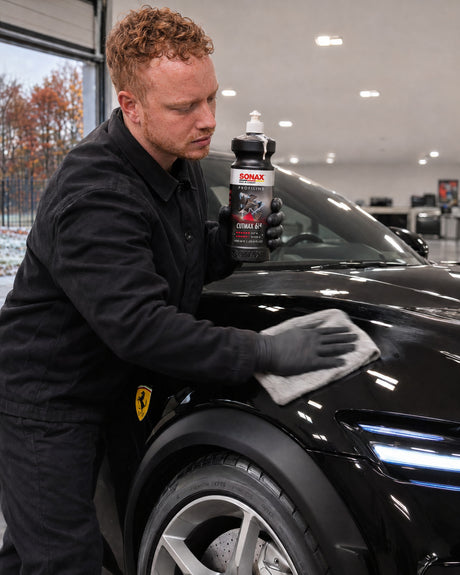
That goes for the G 63 in our photos just as much as for a compact car, and for EVs too. Their battery sits well protected under a tray, but the wheel arches, brake lines and sill edges are built just like on any other car. If you want to keep your car for the long haul, protect these spots while they're still clean and undamaged.

An underbody wash with a pressure washer needs 30 centimetres of distance
An underbody wash at home doesn't start with the pressure washer, it starts with the pre-wash. An alkaline pre-cleaner breaks down the film of road grime, oil and brake dust that glues the mud to the metal. After that, a gentle water jet is enough to rinse it out instead of blasting it deeper into the seams.
The Koch-Chemie Vorreiniger B "Vb" Pre-Cleaner 1000 ml / 1 litre runs at pH 13.1 and is diluted 1:30 to 1:50 for the pre-wash. That turns one litre of concentrate into up to 51 litres of working solution. Apply it from the bottom up on the cold, pre-wetted car, wheel arches and sills first, and give it five minutes' dwell time at most. Don't let it dry on.
For the wheel arches, an alkali-resistant foam sprayer like the iK Sprayers "iK Foam" Pro 2 Alk Foam Sprayer (Alkaline) 1.25 litre does the job. The foam clings to the underside of the arch liner instead of dripping straight off, and you can see exactly where you've already been. At pH 13, seals and a nozzle made of alkali-resistant material aren't a detail, they're what gets the sprayer through the winter.
Then comes the water. Jaguar specifies at least 300 millimetres between nozzle and component in its owner's manual, while guides in the trade press say 30 to 45 centimetres. Aim the jet into the wheel arches and along the underside of the sills, but not straight at brakes, CV boots, connectors or into drain holes. Water forced into a cavity at full pressure stays there instead of draining out.
Allow about an hour per car, more the first time round. After the first pass, the front left wheel arch often looks worse than before, because the mud comes loose and hangs on the edges. That's normal. A second pass with the water jet gets the rest, and after that the water runs clear out of the arch.
Three Koch-Chemie products protect paint, plastic and engine bay
Clean is only half the job. To give the salt less to grip next time, the freshly washed surface needs a protective film, and it has to go on in minutes, because nobody wants to spend hours polishing outdoors in November.
Koch-Chemie Protector-Wax "Pw" Preservation Wax 1000 ml / 1 litre is a preservation wax for the wet car straight after the wash. Koch-Chemie originally developed it for rollover car washes. It preserves paint, rubber and plastic and, according to the manufacturer, reduces the effects of road salt and UV. You mix 30 millilitres into one litre of water, spray it on from top to bottom and rinse off after two to three minutes.
Because Pw is set slightly acidic at pH 4.5, it belongs in an acid-resistant sprayer like the solo CLEANLine (303 A / B) Pump Sprayer 1.25 Litre in the 303 A version. With a capacity of 1.25 litres, one fill covers a whole car including the plastic trim on the sills and wheel arches. Pw doesn't replace a six-month sealant. It builds up further with every wash, every one to two weeks.
The third area is the engine bay, because salty air gets pulled in through the grille there too. Koch-Chemie Motorplast "Mp" Engine Preservation 500 ml lays down a silicone-free, satin-matt film on covers, hoses and components. You spray it into the cleaned, still damp engine bay and it cures over six to eight hours. An engine bay takes 50 to 200 millilitres, and it lasts three to eight months.
One limit belongs in here: none of these products is an underseal in the technical sense. The factory coating of wax or plastic on the floor pan and the cavity protection inside sills and doors remain a job for the manufacturer and a specialist. Our products keep the surfaces clean and preserved where salt attacks first. In the Detailing1 shop, customers rate Vorreiniger B at an average of 4.7 out of 5 stars across 24 reviews.

Car washes and warm parking spots keep the salt on the car
The most common winter mistake is well meant: an underbody wash at the car wash straight after a salty drive. Many car washes use treated process water for the underbody, and in winter that often contains dissolved road salt. The mud comes off the underbody, sure, but it then gets rinsed with salty water.
If you do go through a car wash anyway, pick a day above zero and go for a drive afterwards so the underbody can dry. TÜV NORD and the ADAC advise against car washes altogether below minus ten degrees. The warm wash water then hits frozen-through material, and leftover water freezes solid in door locks and seals. How to treat your door seals before the frost is covered in a separate post.
The second mistake happens after the drive. A car full of salt water parked in a heated space rusts faster than one left outside in the cold. The warmth keeps the water film liquid, and condensation forms. An unheated parking spot or a carport is the better place in winter, odd as that sounds.
The third mistake concerns older cars. If you aim the pressure washer into seams and drain holes, you force water into cavities it can't get back out of. That's the fair point at the heart of the ADAC's scepticism. The answer isn't to skip washing altogether, it's to keep your distance, pick a frost-free day and go for a drive afterwards so the brakes and underbody dry off.
Brake dust deserves its own attention in autumn. Baked-on dust on the wheel binds salt just like the mud in the wheel arch. How to shift it before winter is covered in the post Remove baked-on brake dust before the road salt arrives.
After every salty drive plain water in the right places is enough
If you clean and protect the wheel arches thoroughly now, winter won't take much effort. After driving on salted roads, it's enough to rinse the wheel arches and sills with plain water on a frost-free day, before the salt dries on.
How often that's needed depends on your route. For most cars, one or two thorough underbody washes a year will do, one before winter and one after, with rinses after salty drives in between. Self-service wash bays often have an underbody nozzle you drive slowly back and forth over. It's cheap and at least rinses off the worst of the salt.
Come spring, a look underneath is part of the routine, ideally by a specialist. They'll spot stone chips in the sill coating and places where the factory protection is flaking off before they turn into rust. No preservation helps over existing rust; it keeps working underneath and has to be removed mechanically first.
The same principle applies to the paint up top as underneath: the better it's protected, the less salt sticks. Whether a sealant or a wax suits you better right now is covered in Paint sealant or wax before winter. You'll find the full routine for the wheel arches in 5 wheel arch cleaning mistakes, and all alkaline pre-cleaners in the Pre-cleaner category.
In the end, it isn't one big effort in February that decides it, but a clean start now. A wheel arch without mud has nothing to hold the salt water. The water drains, the metal dries, and after the fifth winter the sill still looks the way it did after the first.

Daniel's tip from practice: I always do the November underbody wash in two stages. First the wheel arches and sills with pre-cleaner and water, then a lap around the block so the brakes dry off. Only then does the Protector-Wax go on the still damp car. If you do both in one go, you often end up spraying the wax onto pre-cleaner foam residue, and the alkaline solution starts breaking down part of the film straight away. A ten-minute break in between makes the difference.
No time for the whole post? Get it summarized:
Add Detailing1 as a preferred source on Google