



Vent dust only comes out dry, and only with a brush
“Is this brush any good for the air vents?” It lands in our chat all the time, usually with a photo of grey vanes that look worse after wiping than before. If you want to clean car air vents, the tool rarely lets you down, the order does: dust gets touched wet before it's out dry. From Tuesday, Nordhorn has an 84 percent chance of rain, and days like that belong to the cockpit.
After this post you'll know why car dust clings differently than at home, the order vacuum, brush and cleaner work in, which bristle stiffness fits which gap, and what to change next time so the vanes stay clean longer.
A rainy week is the right time for the interior
Tuesday and Wednesday bring an 84 and 79 percent chance of rain in Nordhorn, the temperature slides from 21 °C to under 18 °C, and there's nothing to gain on the paint outside. The interior doesn't care about the weather, and you pull dust out of the vanes better with the doors shut than a window open, because no wind is topping it up.
Today is overcast and dry at 20 °C, ideal for airing the car out before the rain and vacuuming the coarse dirt. Exterior work peaks on Saturday, when it dries out again at 19 °C. Until then: inside first, then outside. Use the two wet days and you won't be juggling two jobs come the weekend.
There's a second reason to do this now. After summer the interior carries three months of open-window dust, and on hot days the dash sat at up to 70 °C. At those temperatures plasticisers migrate to the surface, and that slightly tacky film holds dust a cloth won't just pick up.
And one more thing happens in early September: the heating comes on in the morning for the first time, and the blower pushes everything that sat in the ducts all summer through the vents into the cabin. What lands on the dash then is a preview of winter. Why the same vents often smell in September is in our post on car air conditioning; here it's about the dust you can see.
Cockpit dust isn't household dust, and it sticks electrostatically
Vehicle dust is only 8 to 18 percent organic, household dust 52 to 67 percent; the rest in the car is mineral and metallic, mostly brake, tyre and road wear the ventilation sucks in. It's harder and sharper than skin flakes and textile fibres, which is exactly why it scratches when a cloth drags it over piano black or a display.
Then there's surface physics. Dash, vanes and console are polyurethane, polypropylene and ABS, all electrical insulators. Every dry wipe charges the surface, the charge has nowhere to go, and the plastic actively pulls in polarised fine dust. You know the result from every forum: the cockpit is grey again next morning, even though the car just sat there.
Vanes are the worst geometry in the whole car for this. Each has two pivots where the airflow stands still, and that's where whatever the blower delivers settles. On honeycomb vents, which plenty of current models run, the grille doesn't come apart; only bristles and air reach the inner edges. A cloth never gets there, it just pushes the dust deeper in.
And there's the mistake almost everyone makes once. Moisture on loose dust forms a fine sludge in seconds that presses into the plastic's grain and the vane pivots. Once dry, you're left with grey streaks that cost far more work than the dust did. That's why the dry stage here comes before any cleaner.

Cleaning car air vents means vacuum and brush first
Cleaning car air vents runs in four steps: position the vacuum, brush dry, vacuum up, only then go over it lightly damp; in that order the dust ends up in the vacuum, not the cabin air. Hold the nozzle one to two centimetres from the vent, run the vacuum flat out, and work the brush in short strokes from vane towards nozzle.
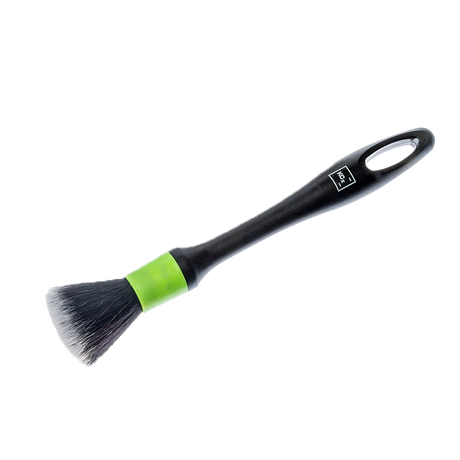
For the vanes themselves, take a 16 millimetre brush: it fits between the bars, reaches the pivots and kicks up very little. With 24 millimetres you work switch banks, button edges, stalks and the gaps around the display; 30 millimetres is for open areas like centre console and door pockets. In our showroom all three run in turn, smallest to largest: the small brush pulls dust from the depths, the big one takes it off the surface.
Only when a stroke no longer visibly kicks anything up does moisture come in, and it goes on the bristles, not the part. Mix an all-purpose cleaner 1:20 with water, spray it on the brush, and wipe the vane faces and surrounds with that. The surfactants lift the greasy residue the dust leaves, and a short-pile microfibre picks the moisture straight back up before it runs into a pivot.
For dust deeper in the ducts, compressed air helps, but only with the vacuum running at the opening and in short bursts. Blast too long or too hard and the thin guide ribs on the vanes snap, so pressure stays under 6 bar and the gun keeps its distance. No compressor? Skip it; brush and vacuum get the visible dust out on their own.
Three bristle stiffnesses and one diluted cleaner cover the cockpit
For vent grilles, button edges and gaps the Koch-Chemie Interior Brush "Gelb" Innenraum Pinsel mittelhart 1 Stück is the right call: fine synthetic bristles with enough spring-back to pull dust from the pivots, and a plastic-sleeved ferrule that won't scratch when it knocks the bezel. The bristles soak up hardly any cleaner, so you can wet them precisely without a drip.
For displays, piano-black trim and the instrument cluster lens that brush is too stiff. Here the Koch-Chemie Interior Brush "Grün" Interior Autodetailing Pinsel weich 1 Stück belongs; its very fine, soft bristle lifts hard road dust off instead of dragging it across. On Trusted Shops it sits at 4.6 out of 5 stars from seven reviews. The red sibling with the stiff bristle is for sill plates and pedals, not vanes.
If you prefer natural bristle, grab the Soft99 Interior Autodetailing Pinsel 24mm, also in 16 and 30 millimetres. Natural hair has a scaly surface, takes up liquid and so works a touch gentler than synthetic; the trade-off is slower drying and no tolerance for strong chemistry. For the lightly damp stage with well-diluted cleaner that's no problem; for neat concentrate it would be.
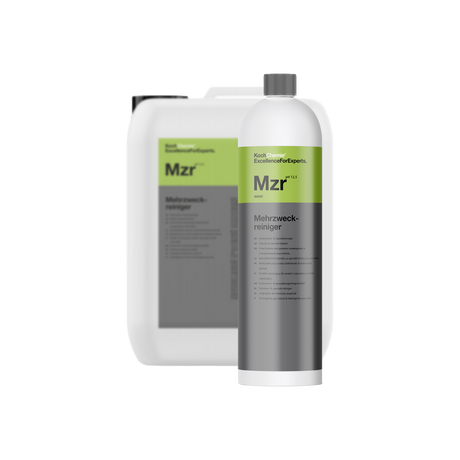
As a cleaner, one concentrate with a clear dilution is plenty. The Koch-Chemie Mehrzweckreiniger "Mzr" Universalreiniger 1000 ml / 1 Liter sits at pH 12.5, is mixed 1:20 for plastics and at that strength stays off leather and soft-touch paint; gloves on for the concentrate. The mix keeps for four weeks, and on Trusted Shops it stands at 5.0 out of 5 from 22 reviews. More options under interior cleaners, every stiffness under brushes & detailing brushes.

Spraying straight into the vents is the most expensive mistake
Spraying cleaner or dressing straight into the vent is the mistake that turns a dust question into electronics damage, because the liquid runs behind the trim into the climate control unit. What misses the electronics collects in the evaporator, dries badly there and becomes the source of October's smell. Product goes on the brush or the cloth, never the part.
Mistake two is starting wet. A lightly damp cloth over dusty vanes makes exactly the sludge that dries into a grey ring in every pivot. Three is the wrong brush: a medium-stiff synthetic on piano black or a display leaves a web of fine scratches, because it pushes sharp-edged road dust across the soft surface instead of lifting it.
Four is the chemistry. Mix an alkaline cleaner too strong for the interior, or leave it unwiped in the sun, and it attacks the plasticisers; the result is pale, cloudy patches no polishing brings back. Hence 1:20 not 1:5, hence the damp wipe-down, hence never on a warm surface. And silicone dash sprays are no shortcut: their gloss film attracts dust and reflects in the windscreen.
Five is blowing out without vacuuming. Compressed air with no vacuum running whips fine dust, brake dust and the flame retardants from the fabrics into the air you breathe, and once the flow stops it all settles back on the same surfaces. Ten minutes later the cockpit looks like before, only this time you've inhaled it. Vacuuming isn't a nicety, it's the core of dust removal.
Less dust next time comes down to the filter and the dressing
The cabin filter decides how much dust reaches the ducts at all, and the TÜV association recommends changing it once a year or every 15,000 to 20,000 kilometres. A clogged filter costs up to 20 percent of blower output, smells musty and fogs the glass faster. In jams and tunnels, recirculation helps too, so the filter isn't swallowing the exhaust of the car in front.
The second lever is the surface itself. A silicone-oil-free plastic dressing like the Koch-Chemie Top Star "Ts" Innenraum Kunststoffpflege 1000 ml / 1 Liter leaves a satin, antistatic finish that lets the charge drain off instead of attracting dust. Application: 5 to 10 millilitres on an applicator sponge, leave it 30 to 60 seconds, buff with a dry microfibre. One litre does around 80 applications.
Two limits apply without exception: keep Top Star off the steering wheel, pedals and gear lever, because the surface turns slippery, and off displays and the instrument cluster lens, where the emulsion can't soak in and leaves milky streaks. On Trusted Shops it sits at 4.7 out of 5 from 35 reviews, and the most common line describes exactly that finish between matt and gloss. Why antistatic does so much against returning dust is in our post on antistatic cockpit care.
The third lever is routine over a big blitz. If you want to clean car air vents without fetching the vacuum every time, do a dry brush pass over vanes and console every second fill-up: five minutes, and the dust never sits in the pivots long enough to bond with plasticiser. Rinse the brushes under clean water afterwards and dry them bristles down. Once the bristle frays the brush is done; from then on it scratches.

Detailing1-Insight: On the black BMW M2, our test car outside the showroom in Nordhorn, I hold a torch flat over the dash before the first stroke: in raking light you see every dust trail that vanishes in daylight, and know where the 16 millimetre brush goes first. On a colleague's daily driver I once started the vanes lightly damp because it looked quicker; three days later every pivot had a grey ring that took me twenty minutes of rework with a brush and Mzr at 1:20 to get out. Since then my rule: dry first with the vacuum running, moisture only once the brush stops kicking anything up, and on piano black only the soft green bristle.
No time for the whole post? Get it summarized:
Add Detailing1 as a preferred source on Google