



5 drying myths that leave water spots behind
The car is washed, squeegeed off and gleaming. Ten minutes later a thin trickle of water runs from the wing mirror down the door, and by the next morning there's a dull streak with a pale edge. Where did that come from when everything was dry? Today is dry, from Friday it turns wet, and on Sunday the next window opens. That's exactly when drying decides whether your paint heads into the rainy days clean.
When you dry your car, water spots almost always come from leftover water drying on the paint: from gaps, from beads sitting on the sealant, from hard tap water or from a towel that only pushes water around. Know these five causes and you'll dry spot-free.
1. Run-off water from gaps drags limescale streaks across the paint
After the squeegee, a car is only dry on the flat panels, because mirrors, door shuts, trim strips, badges and the fuel flap hold on to water and only let it go minutes later.
Run-off water is the number one reason a carefully dried car still shows streaks the next day. After the wash, water sits in the mirror housing, behind the tailgate and in the door shuts, and it runs out as soon as you drive off or open a door. It trickles down as a narrow line over a panel that's long been dry, and nobody wipes it away. Once it evaporates, its mineral content stays behind as a pale ring.
The fix is a set order that plans for the drips. Dry the panels first, top to bottom, then open every door, the tailgate and the fuel flap and wipe out the shuts with a smaller second towel. Then wait about ten minutes and do a second quick pass over the mirrors, the bottom edges of the doors and the rear. Whatever has dripped out in the meantime, pick it up with a dry section of the towel.
A blower saves you that extra step, because it pushes water out of mirrors, badges and lights before it can drip. You don't strictly need a dedicated car dryer for this; plenty of people use a cordless blower or a strong hair dryer on the cold setting. Honestly, it mostly pays off at home. If you wash at a self-service car wash bay and then drive off on wet roads anyway, a towel and a second pass get you just as far.
In autumn this matters more than in summer. At 12 °C hardly anything evaporates on its own, so water stays in the gaps longer and keeps dripping longer. And since you don't want the seals sitting wet when the first frosty nights arrive, wiping out the door shuts belongs in the wash routine now anyway. Then there are the leaves: if one lands on a wet patch, the water leaches tannic acid out of it, which can leave brownish marks on the clear coat.
2. More GSM alone won't stop damp streaks on the paint
GSM only tells you the towel's weight per square metre, not how much it soaks up, and a heavy towel only dries streak-free when its size, pile type and your technique all match.
It's the question we get most about drying towels: how much GSM has it got? Behind it sits the assumption that more grams automatically means more water. That's only half true. A dense twisted loop towel from about 1,000 GSM holds two and a half to over four litres in a large size, a waffle towel more like one to one and a half.
But more capacity doesn't mean fewer streaks. Put two twisted loop towels with similar fibres side by side and they soak up about the same, yet they drag completely differently. A very soft, heavy towel suctions itself to a wet panel and gets hard work. That's when you start pressing down, and that's exactly when fine streaks get left behind.
These damp streaks are the first stage of a water spot. They look harmless because they're thin, but every single one dries in with its limescale. So technique is what counts: lay the towel flat, grab two corners and pull it towards you in one long pass with no pressure. Its own weight does the job. Once a section is saturated, flip to a fresh side instead of carrying on wiping.
The "Aqua" Twisted Loop Drying Towel (1500 GSM) shines with this technique, because the long, twisted loops wick water into the fibre and the towel still has capacity left after the roof and bonnet. At 50 x 80 cm it covers a saloon if you squeegee off the worst first. Its limit is the weight: wet, it gets heavy, and on big panels it needs a steady hand rather than muscle.
The Koch-Chemie Pro Drying Towel 950GSM is lighter, also 50 x 80 cm, and glides noticeably more easily on smooth panels. For a soaking-wet car, an estate or an SUV, two towels are more realistic than one. You'll find more on towel types like twisted loop, waffle and edgeless under Drying towels and in the article Drying Your Car Without Scratches.

3. Sealed paint still gets mineral rings when beads dry on it
A sealant helps water run off, but it doesn't prevent water spots, because every bead that's left standing and evaporates drops its limescale right on top of the protective layer.
We hear this one about paint, wraps and even boats: does a sealant stop water spots? The honest answer is no. It makes the paint hydrophobic, so water pulls together into round beads and runs off more easily. On a ceramic coating the contact angle climbs above 110 degrees, on wax it sits around 90 degrees. Whatever doesn't run off stays put as a little ball. Every one of those beads carries dissolved minerals, and as it evaporates it shrinks into a sharp, pale ring.
On a well-kept sealant those rings still come off easily at first. Leave them baking in the sun for weeks and they start attacking the surface, and the edges lock in. At that point no amount of wiping helps. If you can feel a spot as a ridge with your fingernail, it has already etched into the layer or the clear coat and needs a water spot remover or a polish.
The best defence against drying-in is not letting the water sit as beads in the first place. The SONAX PROFILINE HyperCoat wet sealant is diluted 1:100 to 1:200 with water, sprayed onto the still-wet car and rinsed straight off. SONAX explicitly describes it as a drying aid too, with fast sheeting: the water slides off in big sheets instead of waiting around as thousands of beads. Don't let it dry on hot paint, and it doesn't replace the towel, it just cuts down its workload.
For a car with a ceramic coating the same principle applies, only stricter. Precisely because the coating beads so hard, a lot of beads stay behind after rinsing. Dry it thoroughly and you keep the effect for a long time. Let it air-dry and you're collecting mineral rings on the most expensive layer on the car.
4. Hard tap water leaves limescale on the paint as it evaporates
Tap water is never just water, because dissolved calcium and magnesium salts stay on the paint as it evaporates, and the harder the water, the more visible the ring.
In Germany, water below 8.4 degrees of German hardness (°dH) counts as soft, between 8.4 and 14 °dH as medium and anything above as hard. Your local water supplier can tell you the figure for where you live. In hard-water areas even a single dried bead leaves a clear ring. The shampoo and the foam aren't the problem here, it's the final rinse, whose water stays sitting on the paint.
That's where the most important trick comes in. For the final rinse, take the nozzle off and let the water flow over the car from the top as a continuous sheet with low pressure. That sheet drags most of the water with it instead of leaving fine droplets behind. So most of it runs off before a towel even touches the paint, on sealed paint up to 90 per cent according to hands-on reports. Then work section by section: roof, glass, bonnet, then one side at a time, so no panel dries off while you're not looking.
If your water is very hard, you can do the final rinse with rainwater from the water butt or with demineralised water. Suppliers of these filters quote a total content of 20 to 25 ppm at most as the threshold below which water dries practically spot-free. That's a guideline, not a must. For most people a sheeting rinse in the shade is enough. If you dilute a drying aid, use distilled water for it, otherwise you're just spraying the limescale straight back on.
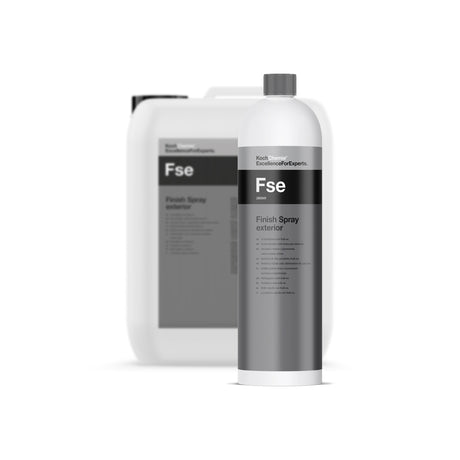
And if fresh mineral rings do appear, the Koch-Chemie Finish Spray Exterior "Fse" breaks them down chemically with its acidic Kalk-EX formula at pH 2.5. On stubborn spots, 30 to 60 seconds of dwell time is enough, then buff off with a second towel. Its limit is clear: it isn't meant for ceramic coatings or fresh wax, because the acid attacks those layers too.

5. Fabric softener clogs your drying towel until it just pushes water around
Fabric softener leaves a film on the microfibre that seals off the tiny capillaries, and a towel treated like that barely absorbs water any more but smears it across the paint instead.
The thinking makes sense: a soft towel should stay soft. With microfibre, fabric softener does the opposite. The fibre works through countless tiny gaps that draw the water in. Gum those up and the water almost beads off the towel. Lots of people only notice when their trusty towel suddenly starts streaking and feels wet after two passes without actually drying the panel.
A dirty towel loses its absorbency too. Residue from shampoo, quick detailer and road film builds up more with every wash. So a drying towel doesn't need the machine after every use, but it does need it regularly, about every ten to twelve uses depending on the manufacturer. In between, just shake the towel out after drying and hang it up to air.
When you wash them, there are only a few rules, but stick to them. Wash drying towels separately, away from cotton, at 30 to 40 °C depending on the care label, with a little detergent or a microfibre wash and no fabric softener. The tumble dryer is fine on low at most; the washing line is better. If a towel is already clogged, wash it a second time with no additives at all. If it still won't absorb after that, it's a good towel for wheels and sills, but its days on paint are over.
If you own two towels, washing them never puts you under time pressure either. One is in use, the other is hanging up to dry. Sounds like a small thing, but it stops you hitting the paint on Saturday with a half-damp towel you washed yesterday, which is saturated straight away.
Four products for a spot-free finish
To dry spot-free you need a large drying towel for the panels, a second towel for gaps and shuts, a drying aid against standing beads and something for fresh mineral rings.
The "Aqua" Twisted Loop Drying Towel (1500 GSM) is the main towel for the roof, bonnet and sides. It soaks up a lot of water and glides calmly with the pull technique. It gets heavy when wet, so on big vehicles fold it and work in stages. The small 40 x 40 cm version is handy for mirrors and door sills.
The Koch-Chemie Pro Drying Towel 950GSM is the second towel, for the door shuts, the rear and the run-off pass. It's lighter and holds a bit less water than the Aqua. On its own it won't get a whole wet SUV dry.
The SONAX PROFILINE HyperCoat wet sealant goes on during the final rinse and gets the water sheeting off. One litre of concentrate at 1:100 makes around 100 litres of spray solution, which is enough for a great many washes. It adds light protection, but it isn't a long-term sealant for the winter.
The Koch-Chemie Finish Spray Exterior "Fse" is the tool for when fresh mineral rings do stay behind, on paint, glass and exterior plastics. On ceramic and fresh wax it stays on the shelf. For those there are dedicated, milder products under Quick Detailer. If spots have already etched in and you can feel them, the article Removing Water Spots From Your Car will help.
If you wash on Sunday ahead of the next rainy week, the order really pays off: sheeting rinse, drying aid, pull the panels, wipe out the shuts, wait ten minutes, pick up the drips. The first time it takes an extra quarter of an hour. From the second time on you've dialled in the routine, and the paint heads into the rain without a single ring.

Detailing1-Insight: A customer with a two-year-old ceramic coating recently described limescale spots to us that, by his estimate, had been sitting on the paint for three to four months, even though the car isn't parked in full sun. Heavy beading is deceptive: the rings form bead by bead and only stand out once they've locked in. Our trick ever since: after drying, wait ten minutes and then go over just the mirrors, the bottom edges of the doors and the tailgate once more. It takes two minutes.
No time for the whole post? Get it summarized: