

Saving cracked leather: why car leather tears in high summer
Jasper von Detailing1 |


| Crowd | Discount |
|---|
Koch-Chemie Spotless Ceramic Finish "Scf" Water Spot Remover for Ceramic-Coated Surfaces - 500ml is on backorder. As soon as everything in your order is back in stock, we ship it all in one go — delivery time follows whichever item takes longest.
Item added to your cart.
View cart

Do you have any questions or need help?
We are sure that our help page will help you. There you will find information on how to contact us and the relevant answers to frequently asked questions.
Didn't find what you were looking for? Write us a message in the chat.
Shipping within Germany from €5.90 with delivery times of 1 to 2 business days. For orders over €89, we ship free of charge with DHL within Germany.
Need your order by the next day? Discover Express Shipping starting from €14.90.
We ship your order to 🇩🇪 Germany, 🇦🇹 Austria, 🇨🇭 Switzerland, 🇳🇱 Netherlands, 🇧🇪 Belgium, 🇱🇺 Luxembourg, 🇫🇷 France, 🇮🇹 Italy, 🇪🇸 Spain, 🇵🇹 Portugal, 🇩🇰 Denmark, 🇸🇪 Sweden, 🇭🇺 Hungary, 🇨🇿 Czech Republic, 🇸🇰 Slovakia and 🇸🇮 Slovenia.
Car Care Store in Nordhorn
Why wait when you can get it fast? Order your car care products from us online and choose between convenient pickup or our lightning-fast delivery, whether locally or throughout Europe. We are dedicated to offering you maximum flexibility and convenience so your car always stays in top condition.
You can always pick up your order from Tuesday to Friday, 10:00 to 17:00, at Bosinks Kamp 8 in 48531 Nordhorn at Detailing1. Please have your pickup confirmation ready. We look forward to your visit.
Couldn't load pickup availability
Spotless Ceramic Finish „Scf“ by Koch-Chemie is a mild acidic water spot remover with glycolic acid, made for ceramic-coated cars. The acid lifts limescale rings in three minutes while a care polymer switches the beading on your coating back on. Not the tool for months-old baked-on limescale crusts or warm paint sitting in the sun.
Spotless Ceramic Finish is an acid-based water spot remover from Koch-Chemie built on 1 to 3 percent glycolic acid with a pH of 3.5 — about as acidic as ordinary cider vinegar, so mild next to industrial wheel acids that sit at pH 1. The glycolic acid works on limescale like a clamp rather than a chemical crowbar: it wraps every calcium particle and makes it water-soluble instead of blasting it loose the way harsh mineral acids do. What that means for you: limescale rings wipe off without residue, and the Si-O-Si network of your ceramic coating — the tight protective lattice of silicon and oxygen that Koch-Chemie, GYEON or CarPro laid onto your paint — stays untouched. On top of that, the formula carries care polymers (trisiloxanes) that switch the hydrophobic behaviour of your existing coating back on in the same wipe.

Day-to-day from Detailing1: Every month we get coated cars in from the Munich area with stubborn limescale rings. At 18 °dH water hardness — standard in Munich, Stuttgart or Würzburg — plus summer heat, the minerals bake into the clear coat in 20 minutes. The pro rule: never let Spotless Ceramic Finish sit on the surface longer than three minutes. Wait ten minutes and you don't pull out any extra effect, you get the opposite — the acid dries on, the calcium ions you'd already bound drop back out as fine streaks, and you end up polishing afterwards instead of just wiping. The trick: a short second pass over the still-damp spot lifts stubborn limescale better than a longer dwell time on the first. Three minutes, wipe, check, repeat if needed.
You spray Spotless Ceramic Finish into a clean microfibre cloth and lay it down as a wafer-thin film on cool paint — never straight onto the panel and never in the sun.
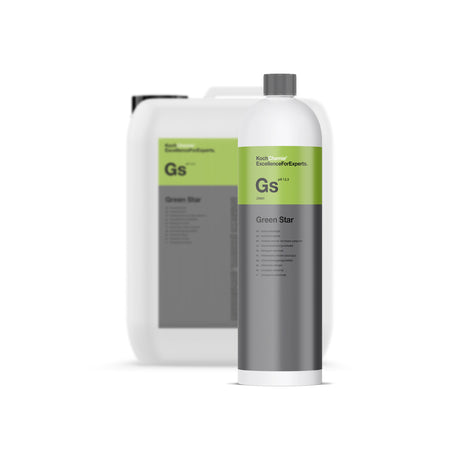
The order is what counts. Before the Scf comes a pre-wash with the alkaline Green Star, which lifts road grime touch-free, followed by a hand wash with the acidic Reactivation Shampoo. Both belong to the official Koch-Chemie workflow for ceramic coatings. Only on clear, thoroughly rinsed paint does the Scf go to work.
Spray the product into the cloth, not straight onto the panel. You want a thin, even film visible on the paint, not a dripping-wet carrier gel. Three minutes is the hard limit on dwell time — any longer and the film dries on and the glycolic acid loses its clamp effect, because the water in the carrier gel has evaporated. The consequence: bound calcium ions drop back out of the gel as streaks, and your car looks worse afterwards than it did before.
After buffing off with a fresh short-pile microfibre cloth, you go over it with a second dry cloth if needed. The used cloth goes straight into the wash solution — the care polymer residue cross-links with the microfibres as it dries and makes the cloth permanently water-repellent if you just set it aside. What that means for you: a forgotten cloth is a lost cloth.
Per 500 ml bottle you're looking at about two to four spritzes per body section, depending on how bad it is. For a full mid-size car reckon on 20 to 40 millilitres — that's about 12 to 25 applications per bottle, depending on section size and whether you work the whole surface or just spot-treat limescale rings. The thin film is the right dose, not the soaking-wet panel.

Spotless Ceramic Finish is a maintenance cleaner, not a brute-force solver for baked-on limescale crusts — at pH 3.5 it simply lacks the crowbar for mineral deposits that have cemented themselves on under weeks of UV heat. Translated: what you missed over breakfast this morning, the Scf pulls off easily. What's been stuck on the car since the April pollen season needs a different tool.
The range of use is wider than the maker documents. Koch-Chemie explicitly names its in-house Cb0.01 and C0.02 coatings, but the glycolic acid is chemically compatible with GYEON Q² MOHS, MOHS+ and Pearl, with CarPro CQuartz UK 3.0, and with the Sonax Profiline Ceramic Coating just as well. Glass coatings like Soft99 Glaco or GYEON Q² View come through unharmed, and so do coated, painted wheel faces.
The clear limits. When limescale has sat on the paint for months and survived several summer-heat cycles, the minerals polymerise into a hardness that pH 3.5 just slides off. Fresh summer-rain limescale → Scf has it. Cement-hard baked-on crusts → knock them back mechanically first with a mild polish, or hit them spot-wise with a more aggressive cleaner at pH 1 to 1.5 — after that Scf comes back as your regular maintenance product.
Never work on warm paint or in direct sun. Heat flashes off the carrier solvents in an instant, the acid concentration spikes locally, and you risk chemical etching in the clear coat. Day-to-day that means: plan at least 15 minutes between parking up and cleaning — the cheapest quality upgrade you can give yourself.
Against other acidic water spot removers, Scf sits in its own niche. Sonax PROFILINE Waterspot Remover works at a similar pH around 3.0 but skips the pronounced gloss booster and delivers cleaner acid cleaning with no visible hydrophobic finish — you'll need a quick detailer afterwards. CarPro Spotless 2.0 runs a proprietary acid blend at pH 4.0 and is typically followed up with a separate detailer. Scf rolls both into one step: acid solving plus care polymer in a single wipe.
On coated wheel faces Scf also works as a targeted spot cleaner against mineral water marks. The glycolic acid lifts the limescale-and-brake-dust mix that clings to the wheel barrel after summer rain, without touching the wheel coating — a handy bonus job between the main paint applications. On coated glass like GYEON Q² View or Soft99 Glaco the product also clears stubborn rain streaks sitting on the coating, without wrecking the beading of the glass sealant.

If you've put 800 to 1,500 euro into a professional ceramic coating and you wash in a hard-water region like Bavaria or Baden-Württemberg, treat Scf like an insurance policy. 16 euro per 500 ml bottle covers around 25 applications — about 0.64 euro per care run.
Geography calls the shots here. In Munich, Stuttgart or Würzburg water hardness regularly tops 18 °dH, which means: over 180 milligrams of calcium and magnesium dissolved per litre of tap water. Wash with the home hose and don't dry within minutes and you produce hundreds of fine limescale rings in a single go. North German coastal cities with soft water under 8 °dH barely have the problem. For coating owners in the hard-water zone, Spotless Ceramic Finish is a standard care step after every hand wash — skip it and you slowly bury your own coating, wash by wash.
Against the rest of the range the price makes the product a sensible insurance. More aggressive rivals like the Italian Innovacar 100% Scale work at pH 1.5 and pack sulphuric and hydrofluoric acid as a crowbar for extremely baked-on crusts — overkill for weekly upkeep on a coated car, perfect for a one-off deep decontamination. Scf positions itself as the caring maintenance product between wash cycles, with a built-in gloss boost instead of a blunt acid finish. More Koch-Chemie products for the complete workflow are in the maker's category.
The ultimate trick for hard-water regions, one no guide spells out this clearly: instead of rubbing the car dry first and then spot-treating water marks, you spray Scf straight into the wet paint after the wash — as a drying aid. The glycolic acid neutralises crystallising salts in the very moment they form out of the evaporating water — before they can bake into the clear coat.
The care polymers push the residual water off the paint at the same time and lay a sliding film between clear coat and microfibre cloth. What that means for you: micro-scratches during drying drop drastically, because the cloth no longer drags against evaporating hard water but glides over a polymer lubricating film. You skip the separate drying step entirely: one job less per car, and at the same time the most effective protection against fresh water spots — this exact workflow runs in the official Koch-Chemie drying-aid tutorial, where the product goes on after the wash instead of before drying.

Not sure about Koch-Chemie Spotless Ceramic Finish "Scf" Water Spot Remover for Ceramic-Coated Surfaces? Get it explained:
Spotless Ceramic Finish is an acid-based water spot remover from Koch-Chemie, based on 1 to 3 percent glycolic acid with a pH of 3.5. The organic hydroxycarboxylic acid acts as a chelator, binding calcium ions in a ring structure and thus dissolving fresh lime rings from ceramic-coated paintwork without attacking the Si-O-Si coating.
Do not spray the product directly onto the paint, but into a clean microfiber cloth, and apply it as a thin film onto the cool, pre-washed paintwork. Leave on for a maximum of three minutes, then buff off with a fresh Reactivation Shampoo-prepared cloth. Two to four sprays are sufficient per section.
Aggressive competitors such as Innovacar 100% Scale work with pH 1.5 and sulfuric acid as a crowbar for baked-on crusts. Scf at pH 3.5 is significantly milder, is designed as a maintenance cleaner for coated vehicles, and additionally contains aminosiloxanes, which reactivate the hydrophobicity of the sealant in the same step.
Koch-Chemie explicitly names its in-house Cb0.01 and C0.02 coatings as approved. Chemically, Scf is also compatible with GYEON Q² MOHS, MOHS+ and Pearl, CarPro CQuartz UK 3.0, and Sonax Profiline Ceramic Coating. Glass coatings like Soft99 Glaco or GYEON Q² View, as well as wheel coatings, remain undamaged.
The glycolic acid dries, and the bound calcium and magnesium ions precipitate back onto the paint as streaks. You then have to re-polish instead of simply wiping off. For heavier contamination, a second short pass on the still damp area is more effective than a longer exposure time during the first application.
For a mid-size vehicle, you will use 20 to 40 ml as a drying aid application distributed over all body sections. A 500 ml bottle therefore lasts for approximately 12 to 25 applications — at a list price of €15.99, the cost per treatment is between €0.64 and €1.33.
The complete preparation workflow precedes the Spotless Ceramic Finish. First, wash the vehicle touchlessly with the alkaline Green Star pre-cleaner, which dissolves coarse road grime without a brush touching the paint. This is followed by hand washing with the acidic Reactivation Shampoo, which was specially formulated for the care of ceramic coatings. After thorough rinsing, the vehicle must be completely dry.
Never spray Spotless Ceramic Finish directly onto the paint. Apply two to four sprays per body section to a clean, short-pile microfiber cloth and spread the product as a wafer-thin film over the area to be treated. A uniform moist shimmer should be visible on the paint, not a soaking wet carrier gel. For a mid-size vehicle, expect 20 to 40 ml of consumption - that's about 12 to 25 applications per 500 ml bottle.
The maximum dwell time is three minutes. Then, buff off the product with a fresh, short-pile microfiber cloth in straight lines. For stronger limescale rings, a second short pass on the still damp spot is more effective than waiting longer during the first. If necessary, wipe with a second dry cloth to remove any residual films.
Notes: Spotless Ceramic Finish works reliably against fresh limescale rings on ceramic coatings such as Koch-Chemie Cb0.01 and C0.02, GYEON Q² MOHS, MOHS+ and Pearl, CarPro CQuartz UK 3.0, and Sonax Profiline Ceramic Coating; glass and rim coatings remain unharmed. For months-old baked-on limescale crusts, a pH value of 3.5 is not sufficient — here, gently tap with a mild polish beforehand, or use a more aggressive cleaner with a pH of 1 to 1.5 in a targeted manner. Never work on warm paint or in direct sunlight — the carrier solvents evaporate rapidly and the acid concentration increases massively locally, which can lead to etching in the clear coat. Allow at least 15 minutes between parking and cleaning. Immediately soak the used microfiber cloth in microfiber detergent, as the siloxane residues crosslink with the fibers when drying and make the cloth permanently water-repellent. Store frost-free between 5 and 30 °C, use within 24 months after opening.
Hinweise für Koch-Chemie Spotless Ceramic Finish "Scf" Water Spot Remover for Ceramic-Coated Surfaces
Privatkundenkonform
Das hier als „Privatkundenkonform“ gekennzeichnete Produkt ist nach deutscher Gesetzgebung privatkundenkonform verpackt, deklariert, angemeldet und zertifiziert. Beachte bitte die Gefahren- und Sicherheitshinweise.
Materialzusammensetzung
2-(2-Butoxyethoxy)ethanol Substance with an EU exposure limit value. (CAS 112-34-5, EC 203-961-6, Index 603-096-00-8) — 10- < 25 %, 3-Butoxypropan-2-ol (CAS 5131-66-8, EC 225-878-4, Index 603-052-00-8) — 10- < 25 %, 1-Methoxy-2-propanol Substance with an EU exposure limit value. (CAS 107-98-2, EC 203-539-1, Index 603-064-00-3) — 5- < 10 %, 1,1,1,3,5,5,5-Heptamethyl-3-octyltrisiloxane (CAS 17955-88-3, EC 241-881-3) — 1- < 10 %, Poly(dimethyl)[3-((2-aminoethyl)amino)propyl]methylsiloxane (CAS 71750-79-3) — 1- < 3 %, and Glycolic acid (CAS 79-14-1, EC 201-180-5) — 1- < 3 %Gefahr

Verätzungsgefahr

Gesundheitsschädlich
| Verursacht Hautreizungen. | H315 |
| Verursacht schwere Augenschäden. | H318 |
| Ist ärztlicher Rat erforderlich, Verpackung oder Kennzeichnungsetikett bereithalten. | P101 |
| Darf nicht in die Hände von Kindern gelangen. | P102 |
| Schutzhandschuhe/Schutzkleidung/Augenschutz/Gesichtsschutz tragen. | P280 |
| BEI KONTAKT MIT DEN AUGEN: Einige Minuten lang behutsam mit Wasser ausspülen. Eventuell vorhandene Kontaktlinsen nach Möglichkeit entfernen. Weiter ausspülen. | P305+P351+P338 |
| Sofort GIFTINFORMATIONSZENTRUM/Arzt anrufen. | P310 |
Downloads
Sicherheitsdatenblatt herunterladen
Diese Produktinformation soll und können dich nur unverbindlich beraten. Eine Haftung unsererseits kann hieraus nicht abgeleitet werden. Prüfe bitte, ob das Produkt für deinen Anwendungsfall geeignet ist. Vor der Anwendung auf Eignung und Verträglichkeit prüfen. Zur Beratung stehen wir Dir gerne zur Verfügung.
Fragen zu den Hinweisen?
Contact
Choose from many payment methods such as PayPal, Klarna, Apple Pay, Mastercard or Visa and benefit from purchase on account and installment payments. Your payment information is always processed securely. Questions about payment?

Your order will reach you in just 1-2 days with DHL, DPD or UPS from €5.90. Shipping with DHL is free for orders over €89. Need it faster? Choose from our express shipping offer. We attach great importance to sustainability, which is why our shipping with DHL and DPD is climate-neutral. Questions about shipping?
Jasper von Detailing1 |

Jasper von Detailing1 |

Jasper von Detailing1 |

Daniel von Detailing1 |

Daniel von Detailing1 |

Daniel von Detailing1 |

Daniel von Detailing1 |

Daniel von Detailing1 |

Daniel von Detailing1 |

Daniel von Detailing1 |

Daniel von Detailing1 |

Daniel von Detailing1 |