



Soak up the water instead of pushing it around: how to dry without water spots and scratches
Most scratches in the paint don't happen during the wash, they happen in the ten minutes after it. The car sits clean in front of you, the water runs off in sheets, and now you grab whatever cloth is lying around. Those minutes decide whether the paint looks flawless in the evening or whether the next bit of sunlight shows you fine marring and white lime rings.
A microfibre car drying towel pulls the remaining water into the fibre by capillary action instead of pushing it across the paint. That is why it dries more safely than a chamois, a water blade or cotton, and why the choice between twisted loop, waffle weave and hybrid decides over water spots and scratches.
This question about drying towels for cars lands with us almost every week: what is the towel for, how do I use it, and what should I watch out for? If you're planning your next wash, here is the answer in six steps. First the material, then the weave types, then the criteria, then the workflow, then our selection, and at the end the match: which towel fits which problem.
A drying towel works with capillary force, not with pressure
A car drying towel is a microfibre cloth made of polyester and polyamide whose split fibres draw water inwards by capillary action as soon as the towel lies flat on the wet paint. The polyester forms the tear-resistant backbone of the fibre. The polyamide is the soft, water-loving part that carries the absorbency and the gentleness on paint.
This ratio is the first number that counts on a drying towel. At 70/30, that is 70 percent polyester and 30 percent polyamide, you have the standard for premium drying towels. At 80/20 you get a tougher, noticeably rougher towel with less capacity, the kind you find in all-purpose cloths and budget dryers. For wet clear coat you want the higher polyamide share.
Why not just a clean bath towel? Cotton has no split fibre and no pile depth. A grain of sand still sitting on the paint after the wash gets dragged across the panel by cotton, chamois or a silicone water blade and leaves a long scratch. A microfibre towel with a deep pile tucks that grain up into the weave before it does damage. That is the real reason why the water blade and the chamois no longer get a recommendation on modern, soft paint.
Water spots themselves only form once the remaining water evaporates. Whatever was dissolved in the tap water, above all calcium and magnesium, stays behind as a white ring. In Germany, water up to 8.4 degrees of German hardness counts as soft, between 8.4 and 14 as medium and above that as hard. The harder your water, the shorter the window between the final rinse and dry paint.
Twisted loop, waffle, plush and hybrid dry differently
Twisted-loop towels soak up water fastest and glide with the least friction, waffle towels are lighter and can be wrung out more often, plush forgives leftover grit best. So the weave decides not only how much water goes into the towel, but also how the towel behaves on the paint.
In a twisted loop, long, tightly twisted loops stand upright on the base fabric. They massively increase the contact area with the water and pull even the fine droplets off a ceramic coating in one pass. In return, a large twisted-loop towel gets heavy when wet, and above 1,200 grams per square metre you can barely wring it out by hand any more. That is the honest limit of this weave.
The waffle weave works with ridges and channels. The channels carry the water into the core of the towel, the ridges pick it up mechanically. A waffle towel holds less volume than a twisted loop, but stays handy and dries out again faster. On coated cars, where the water beads hard anyway, it collects the droplets very efficiently. On glass it leaves no lint, which you can't take for granted with plush.
Plush is the classic, fluffy weave with a long, open pile. It holds a lot of water and buries leftover grit best, but on very hydrophobic coatings it often just moves micro-droplets around instead of absorbing them. Hybrid towels marry two fibre worlds: THE COLLECTION combines twisted-loop fibres with soft pluffy fibres in the "Striped 2.0", so the capillary pull of the loops and the gentle glide of plush live in one towel.

When choosing, fibre ratio, weight, size and edge are what count
You can spot a good car drying towel by four numbers and one seam: 70/30 as the fibre ratio, 600 to 1,500 grams per square metre as the weight, a size that matches the panel, and an edge that never touches the paint. Everything else is marketing.
The weight in GSM, grams per square metre, describes how much fibre material sits in the towel per unit of area. It correlates directly with capacity: a 1,500 GSM towel in 50 by 80 centimetres soaks up between 3.6 and 5 litres of water and dries an estate car without a single wring-out. But more GSM doesn't automatically mean better. Above 1,200 GSM the wet towel gets so heavy that many people unconsciously build up pressure and push the towel instead of letting it glide.
That is why the sweet spot for a main towel sits at 900 to 1,000 GSM in 50 by 80 or 60 by 80 centimetres. That covers roof and bonnet in a few passes but stays controllable in one hand. For windows, badges, door shuts and mirrors you want a second, smaller towel of 400 to 600 GSM in 40 by 40 centimetres, because the big, wet main towel only grinds in tight spots.
The edge is the danger zone hardly anyone checks. Hot-cut, fused edges or a hard polyester seam scratch the moment you drag them across the paint. Premium towels solve this with an edgeless laser cut, a soft silk banding or a seam folded to the inside. And before the first use you carefully tear off the sewn-in care label instead of cutting it: a cut-off stub is the sharpest edge on the whole towel.
The workflow decides: reduce the water first, then blot from top to bottom
Drying starts with the final rinse: without the nozzle the water runs off the paint as a closed sheet, and afterwards the drying towel has to absorb up to 80 percent less water. In the scene this technique is called sheeting, and it works best on waxed and sealed cars, because the surface tension there pulls the water together anyway.
Then comes the order gravity dictates. Roof first, because otherwise run-off water re-wets the flanks you've already dried. Then the glass, because lime burns in visibly fastest on glass. After that bonnet and boot lid, the big horizontal panels where droplets sit. Only then doors and flanks, and last mirror housings, door handles, grille, number-plate recess, sills and wheels. For the last two you use a separate towel in a different colour.
The movement itself is blotting, not rubbing. You lay the big towel flat on the bonnet without pressure, wait a few seconds until the capillary forces have pulled the water up, and then draw it off the panel by the front corners in one straight line. When the towel starts leaving micro-droplets instead of a dry pass, it is saturated: wring it out or grab the second towel. Circular, rubbing motions belong to the chamois, not to microfibre.
If you have hard water or have to dry in the sun, you mist a drying aid onto the wet paint before the towel: a quick detailer or a spray sealant the manufacturer approves for damp surfaces. The film lowers the friction between towel and clear coat and breaks the surface tension of the remaining water, which then contracts and goes into the towel more easily. Two or three sprays per panel are enough, more product only smears.
A timing mistake costs more than any towel: if the car sits in the sun after the wash, every droplet acts like a tiny lens and burns the lime into the clear coat. Water spots etched in like that can no longer be washed off, they need machine polishing. How to recognise them and what still works on fresh spots is in our article Preventing and removing water spots on car paint.

Our selection covers twisted loop, waffle and hybrid
At Detailing1 you'll find a car drying towel we use ourselves for each of the three weaves, plus the quick detailer that dissolves lime spots again if the timing did slip for once. All four sit in the drying towels category, the matching finishing and glass cloths in the microfibre cloths category.
The main towel for most cars is the THE COLLECTION "Striped 2.0" hybrid-fibre microfibre drying towel (950 GSM), 1 piece / 50 x 80 cm / light grey. Its 950 GSM sit exactly in the range where a towel holds a lot and still stays controllable, and the mix of twisted-loop and pluffy fibres glides more softly on sensitive dark paint than a pure loop towel.
The limit of the Striped 2.0: for a big SUV after rain you need a second towel or one wring-out. For a saloon, hatchback or coupé a towel this size almost always does the job in one pass if you follow the right order.
If you want a waffle towel in a large format, grab the Meguiars WATER MAGNET Drying Towel, 1 piece. At 55 by 76 centimetres it covers bonnet, roof and flanks of a normal car, and the waffle weave holds the water in the core instead of giving it back on the next pass.
Meguiars specifies 40 degrees on a gentle cycle without fabric softener for care. On freshly coated paint with very strong beading it is in its element, on very soft paint a twisted loop glides that little bit more gently.
For cars with a ceramic coating we recommend the GYEON Q²M WaffleDryer EVO waffle microfibre drying towel, 1 piece / 60x80 cm / blue, and as a second towel for glass and door shuts the 40x40 cm version. The waffle channels pick up the beading droplets without pressure and need wringing out less often. As a single towel on unprotected, very wet paint, however, the 60x80 size saturates faster than a 950 GSM twisted loop.
If you simply want a reliable, large drying towel for every Saturday, go for the SONAX PROFILINE MicrofaserTrockenTuch "PLUS" microfibre cloth, 1 piece at 520 GSM in 80 by 50 centimetres. SONAX explicitly describes the technique as pulling without rubbing afterwards, with the occasional wring-out, and it gets washed at 40 degrees max without fabric softener. It is not a loop towel and takes up less per pass than the Striped 2.0, but it is light, dries out again quickly and forgives everyday use.
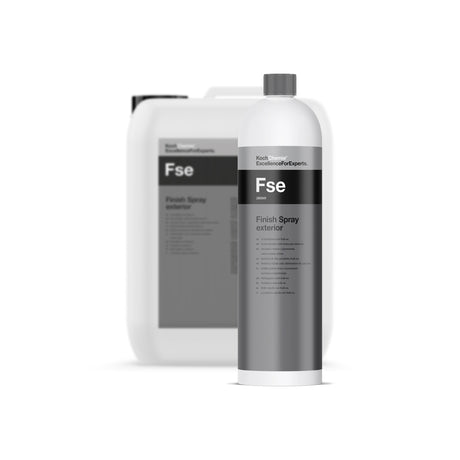
And if the spots are already there: the Koch-Chemie Finish Spray Exterior "Fse" Quick Detailer with Kalk-EX, 1000 ml / 1 litre works at a pH of 2.5 and chemically dissolves fresh lime rings on paint, glass and plastic, where a neutral quick detailer only spreads them. It won't help against spots etched in last summer, those sit in the clear coat and need the polisher.
Which towel fits which problem
If your car wears a ceramic coating and the water stands in small beads, take a waffle towel; if the paint is unprotected and the water runs off in sheets, take a twisted loop or the hybrid with 950 GSM. That is the ground rule, everything else is a special case.
If your paint is black or very soft and you spot new swirls with every ray of sun, safety beats volume: the hybrid towel, blotting instead of pulling, and a drying aid on the wet paint. If your car is an estate, van or SUV you need volume: either a very heavy twisted-loop towel or the two-towel method, where the big towel takes the panels roughly and the small waffle towel finishes.
If your tap water is hard, meaning above 14 degrees of German hardness, speed counts more than weave: sheeting during the rinse, drying in the shade, two towels in parallel, and a small blower for mirrors, handles and shuts so nothing runs out later.
If you want no contact with the paint at all, a filtered car dryer is the top tier, because it filters the air and blows it out 15 to 45 degrees warmer than the surroundings. A leaf blower, by contrast, sucks in unfiltered air complete with dust from the yard, and a workshop compressor blows oil droplets along with it.
If your towel suddenly leaves a wet smear instead of absorbing, it is almost always fabric softener or a dryer sheet from the last wash. The cationic surfactants wrap the fibre in a water-repellent coat.
How to open the towel up again with a microfibre detergent at 40 to a maximum of 60 degrees, and why a tumble dryer on the cold setting stands the loops back up, is explained in our article Washing microfibre cloths: temperature, detergent and fabric softener. A well-kept drying towel lasts 50 to over 100 washes before it moves to the second row as a sill towel.
And if the towel falls on the floor while drying, its job on the paint is over for today, no matter how clean the yard looks. The fine polyamide fibres grab quartz sand and metal grit like a magnet, and neither shaking it out nor a normal wash gets every grain out. The towel goes in the wash, a fresh one goes on the paint.
Detailing1 insight: A new drying towel absorbs worse on its very first use than on its second, because dry, factory-fresh microfibre has to be wetted first. We wash every new towel once without fabric softener at 40 degrees and dampen it slightly before the first car. On a black bonnet you see the difference immediately: a bone-dry towel pushes the first two passes ahead of itself, a slightly damp one pulls the pass dry in one go. The same applies when the towel comes off the line stiff as a board.

No time for the whole post? Get it summarized: