



Car leather cracks from heat, not from age
A customer wrote to us this week about his two-year-old car. One tiny spot on the seat cushion, caught by a jeans button, barely bigger than a fingernail. But you can see it. By the time you are trying to save cracked leather, you are already late. Spots like that are rarely an accident, they are the end of a chain that starts in high summer, long before anything shows.
Cracks in modern car leather come from heat, moisture loss and friction, not from age. Break the chain at any one point and the damage never happens. Wait until the crack is visible and all you can do is hide it.
The damage starts at 71 degrees on the seat bolster
In a car that has stood in the sun for an hour, the seat bolster passes 71 degrees surface temperature while the humidity inside the cabin drops below ten percent. Two numbers that together do more harm than any scratch.
Modern automotive leather is no longer a natural material, it is a layered composite. At the bottom sits the collagen fibre network, loaded with fatliquors that keep the fibres from grinding against each other when they move. Above that sits a pigmented colour layer, and on top a clear coat of cross-linked polyurethane. That top layer carries all of the abrasion resistance. Everything you touch on the seat is plastic.
Polyurethane has two glass transition temperatures. The term describes the point where a hard polymer flips into a soft, rubbery state, much like chocolate losing its shape in your hand. The soft segments of the top layer only flip at minus 32 to minus 43 degrees, which is why leather stays supple through winter.
The hard segments, the ones doing the scratch resistance, sit at around 78 degrees. What that means for you: on an afternoon with 71 degrees on the seat, your car's protective layer is already working at the edge of what it can take, while you stand in the shade and notice none of it.
A second process runs alongside. Warm air holds exponentially more water vapour, so relative humidity in a closed cabin drops below ten percent on hot days. Below roughly 35 to 40 percent, leather gives up bound moisture and light fatliquors to the air until it reaches equilibrium. The fibre structure shrinks measurably as it does. Since the leather is stretched tight over foam and frame, that puts permanent tension on a surface that is losing its lubrication at the same time.
Then there is plasticiser migration. Heat mobilises the small, volatile molecules in the top layer, they travel outward and gas off. You see the result as a greasy film on the inside of the windscreen, which the industry calls fogging and measures with its own standards. What lands on the glass is missing from the leather afterwards. What is left is a top layer stripped of the parts that kept it flexible.
Crazing first and only one of the two stays reversible
Crazing is a fine web of cracks in the polyurethane top layer and you can stop it. Cracking is the fracture of the leather fibre underneath and it is final. That distinction decides whether a spot can still be saved.
Damage almost never starts in the leather itself, it starts up in the coating. Under constant tension and shear, combined with temperature peaks and the loss of plasticisers, the long polymer chains come apart from each other. What forms is a hair-thin, web-like pattern of micro-cracks, hard to tell from the natural grain with the naked eye. In practice it means the barrier is open. Sweat, dust and UV now reach the fibre network underneath with nothing in the way.
Once the barrier is through, fatliquor loss in the corium speeds up. The fibres grind against each other dry with every shift of your weight, lose their tensile strength and break. The result is the crack you eventually see. You can close it visually with filler and colour, but the broken fibres do not grow back together.
That is exactly where the line runs: saving cracked leather works reliably at the crazing stage and only cosmetically at the cracking stage. Which is why every minute spent on the phase before it pays off.
Cracks do not spread at random. By far the most common spot is the bolster on the driver's side, right where you slide over the edge getting in and out. Sliding in puts a large share of your body weight through a small contact patch onto the flank and stretches the top layer to one side. It is the same spot the repair videos on the subject show: a tear on the driver's bolster, from catching it with a pair of trousers.
Second most common are seams and seat edges. Every perforation is a mechanical weak point where tension concentrates. When the leather shrinks in summer, these areas go first.
The steering wheel follows its own logic. There is barely any tension on it, but maximum chemical attack from skin oils, sweat salts, hand cream and direct UV through the windscreen. Another quiet accelerator is everyday dirt. Fine sand and textile fibres collect in the pores and the grain, get pressed into the material as you sit down and work like very fine sandpaper with every shift of your hips. Sunscreen and indigo off denim make it worse still, as we covered in our piece on dark marks on light leather.

Cleaning beats conditioning because dust works like sandpaper
The most effective protection against cracks is not the conditioner, it is the clean. Lay a conditioner onto unwashed leather and you massage the abrasive particles permanently into the pores and lock them in.
That sounds unspectacular and it is still where most summer damage happens. The dirt that wears down the top layer is not the visible mark, it is the fine film sitting in the grain. A care product goes over it, glues it to the surface and turns loose dust into a bound grinding paste. From then on every drive works against your own top layer.
For the clean, pH decides. Leather cleaners that are safe on pigmented smooth leather sit in the neutral window between pH 7.0 and 7.5. Alkaline all-purpose cleaners above pH 9 make the polyurethane dispersion swell and pull plasticisers out of the matrix, and the leather feels dull and hard afterwards. Alcohol-based products like glass cleaner or disinfectant physically attack the top layer, because alcohol is an excellent solvent for polyurethane. Translated: with the wrong cleaner you wipe the protective layer off in small amounts.
Mechanics are the second lever. Stiff brushes and rough household sponges create exactly the crack pattern we are trying to avoid, just by hand. A soft brush or a microfibre pad moves the foam without pressing down. Give the chemistry the time to release the dirt, and let the tool only lift it off.
After a wet clean the leather has to dry all the way through, ideally several hours with the windows open in the shade, before the protection goes on. A protective film on damp leather does not cross-link properly and loses exactly the effect you applied it for.
What belongs on coated leather and in what order
Modern leather care feeds nothing, it works on the top layer. Its three jobs are cutting friction, blocking UV and slowing evaporation, and that is exactly how you pick the product.
An intact polyurethane layer is minimally microporous, but it does not let large fat or wax molecules through. Heavy oils sit on top. What works are water-based emulsions and light polymers that leave a dry, non-tacky film once they flash off. That film lowers the friction coefficient of the surface. In practice: the hard denim of your jeans glides over the bolster as you get in instead of catching in the coating. It is the most effective chemical protection against micro-cracks there is.
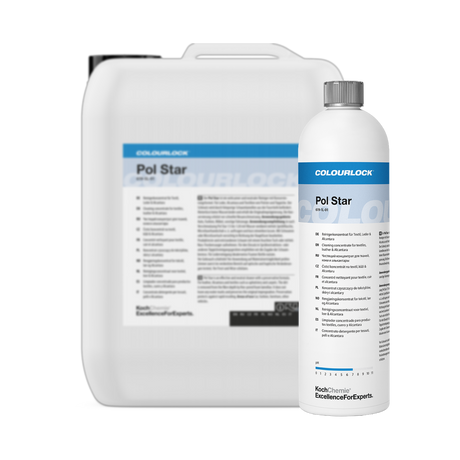
For the clean, the COLOURLOCK "Leather Cleaner" (Mild) 250 ml is the everyday grab for well-kept, normally soiled smooth leather, because it lifts oils and abrasion without attacking the top layer. If you want to do leather, Alcantara and fabric in one pass, the COLOURLOCK "Pol Star" 1000 ml / 1 Liter takes you further, diluted 1:20 on leather and lasting a very long time per litre. Users consistently report that it stays gentle on those delicate surfaces, confirmed by verified reviews at Trusted Shops.
For the protection step after that, the COLOURLOCK "Leather Shield" 100 ml is the right answer to the friction problem, because it builds exactly that invisible anti-friction film and holds the factory matte look instead of adding shine. If you prefer a classic conditioner with a satin-matt finish, grab the THE FINISHER "LeatherLock" 500 ml. If the leather has already gone hard and brittle, the COLOURLOCK "Old Leather Softener" 250 ml comes before any protection and brings suppleness back into stiffened fibres. It is the step that lets you save cracked leather while the fibre still holds.
Which cleaner is allowed on your leather at all depends on the leather type, and you should establish that first. Our piece on identifying your leather type shows you how in two minutes. The full range sits in our categories leather cleaners and leather care.

Olive oil, milking fat and the more-is-better myth
The most common mistake at home is over-saturation. A thick coat of conditioner does not soak in, it sits there as a film, turns liquid on the next hot day and catches every grain of pollen and sand.
You can see the thinking behind it: dry leather should be allowed to drink. With a closed polyurethane top layer there is simply no capacity for larger amounts. The excess stays on top and becomes a glue trap at 50 degrees cabin temperature. Well-meant care then creates exactly the sandpaper effect on the driver's bolster that it was supposed to prevent. So the rule runs the other way: lay it on paper-thin, let it flash off for a few minutes, then take it all back off with a clean, dry, short-pile microfibre towel without pressure.
Home remedies hang on stubbornly and they are the worst option on coated leather. Olive oil does not go into the top layer, it oxidises on the surface, turns rancid and forms sticky resins. Milking fat and body lotion leave a film of grease once the water evaporates, which shines and works as a dust magnet. Both speed up abrasion instead of slowing it.
Cheap dashboard sprays with a high silicone content seal the pores completely, shut down moisture exchange and leave a greasy shine that dazzles in the sun. On the steering wheel that is more than a cosmetic problem, because you lose your grip.
The third classic is timing. Work on a hot Saturday afternoon in the sun and your cleaner flashes off the moment it hits a seat sitting above 50 degrees, pulling the loosened dirt back into the grain. The conditioner cannot flash off, it bakes on and leaves streaks instead of an even film.
The first time round the whole job feels longer than it is. For the two front seats you will want a good hour at first, by the third time it is twenty minutes. That is part of it and no sign that you are doing something wrong.
A sunshade beats any conditioner
No care product suspends thermodynamics. The most effective and cheapest protection against cracking in high summer is a reflective sunshade behind the windscreen.
The maths is simple. The shade throws the infrared back and drops the surface temperature of the dashboard and the front seats well before they reach the 71 degrees where the hard segments of the top layer go soft. Parking in the shade and cracking a window open work the same way: air circulation stops the extreme heat build-up, keeps relative humidity above the critical mark and slows both the drying out and the plasticiser migration.
After that it comes down to intervals, and those depend on the part rather than the car. The steering wheel wants a mild, strictly pH-neutral clean every two to four weeks in summer to take the greasy film of skin oils off. A conditioning product explicitly does not belong there, because it makes the wheel slippery. After the clean a dry protective film is enough.
The driver's seat, and the entry bolster in particular, wants cleaning and re-protecting every four to six weeks with daily use, so the friction coefficient stays permanently low. The passenger seat and the rear bench get by on three to six months, one thorough round in spring and one after the summer. Care for those low-use areas monthly and you land straight in the over-saturation above. Convertible drivers cut the cycle to two or three weeks in high summer, because without a roof the full UV load sits on the leather.
For this week that means: Wednesday and Thursday hit 34 and 32 degrees, the hottest days, when nobody works inside a car sensibly and the shade makes the biggest difference. From Saturday a dry and noticeably cooler window runs through to Monday. That is the slot for cleaning, a drying break and the protection step, in that order and in the shade. For the rest of the interior in the right sequence, see our piece on the interior in summer.

Jasper's tip: Almost every leather enquiry reaches us only once the spot is already visible. It is nearly always the same one: the driver's bolster, usually after two or three summers, and nearly always on cars that sit out in the sun all day. What genuinely bothers me is the order people invest in. They buy the expensive conditioner and leave the shade on the shelf. If I could only do one thing for a summer, it would be the shade plus one proper clean. The protective film comes after that, and then it actually works.
No time for the whole post? Get it summarized:
Add Detailing1 as a preferred source on Google