



When you clean a car interior, the surface decides, not the household trick
The washing-up liquid tip does the rounds on every other car forum, and it sounds sensible enough: a squirt of dish soap in warm water, cloth in, done. Right up until three days later, when you've got pale rings on the dashboard and the headliner is peeling at one corner. Inside the car, the priciest mistake doesn't shout, it whispers.
Cleaning a car interior means lifting dirt without attacking the surface underneath. Some household remedies do exactly that; others wreck leather, Alcantara and adhesive. This guide splits the two and shows you the point at which a surface needs pH-matched chemistry.
Cleaning the interior means lifting dirt without attacking the surface
Cleaning a car interior means lifting dust, grease and greying without the surface underneath taking a hit. That's the whole difference between clean and damaged. The mistake almost never starts with the scrubbing, it starts with which product you reach for.
A car interior isn't one single material, it's a patchwork of hard plastic, soft-touch coating, fabric, Alcantara, leather, rubber and glass. Each of those surfaces has its own tolerance for chemistry. A cleaner that does nothing to the hard plastic on the centre console can dry out the top layer on a leather steering wheel and mat down the Alcantara.
The second thing is the order you work in. Start with a cloth and all you do is drag dry dust across the surface and rub fine scratches in. The vacuum comes first, moisture only after that. We went into just how much the sequence matters in the piece Cleaning your car interior is order before cleaner.
And the third thing is how much water you use. An interior forgives too little moisture easily; too much, hardly at all. Standing damp creeps into seams, under trim panels and into the foam behind the fabric. Ignore that and you've traded one stain for a musty smell, and worst case for mould.
Interior cleaning is having a moment right now, and that's down to the weather. On rainy days the detailing moves indoors, and the interior is the bit we touch every day and deep-clean the least. Which is exactly why it pays to get it straight once, which product belongs on which surface, instead of repeating the same half-mistake every weekend.
The vacuum, microfibre and distilled water are the honest household kit
Three household items genuinely work on an interior, and not one of them is a cleaner: a decent vacuum, tightly woven microfibre cloths and distilled water. That covers about eighty percent of normal grime.
Distilled water sounds like overkill, but it's the underrated trick. Tap water brings limescale with it, and that dries into a pale ring, most visible on dark Alcantara and black hard plastic. A five-litre jug from the supermarket costs next to nothing and takes that annoyance off your hands. For most surfaces, a lightly dampened cloth with nothing added does the job.
With cloths, a tightly woven one earns its keep. A short-pile, edgeless microfibre cloth around 300 to 400 grams per square metre picks dirt up instead of spreading it around, and it won't scratch. For air vents, seams and the corners around buttons, a soft detailing brush is the right tool, because it pulls dust out of the gaps no cloth can reach. That's actually one of the questions we get most in support: whether a brush is any good for the dashboard vents. The answer is yes, as long as the bristles are soft.
On glass, an ordinary glass cleaner works fine, as long as you spray it onto the cloth and not straight onto the screen, so nothing runs onto sensitive sensors or controls. The inside of the windscreen carries a thin film of off-gassing plasticiser that dazzles you when the sun's low. You get that off with glass cleaner and two cloths, one to break it up and a dry one to buff.

Vinegar, dish soap and too much water do the most damage
The most popular household remedies are also the most dangerous: vinegar, dish soap and the well-meant bucket of water. All three shift dirt in the short term and leave damage in the long term that costs more than any pro chemistry ever would.
Vinegar is an acid, and acid has no business in a car interior. On leather it attacks the top layer and the stitching; on aluminium trim it etches matt spots; and the smell hangs around for days. Dish soap, for its part, is built for grease on dinner plates, not for coated surfaces. It leaves a film that positively attracts dust, so the surface looks dirty again faster than before you started.
The usual all-purpose household cleaner is strongly alkaline, and that's a different problem. On soft-touch surfaces like modern dashboards, the caustic loosens the rubberised coating, which then turns sticky and can't be saved. On light upholstery, aggressive cleaners bleach patches that never blend back in.
The popular wet wipe from the chemist's isn't a good idea either. Most of them carry surfactants and preservatives that leave a sticky film, and the alcohol in them dries leather out. On displays and glossy controls there's the added issue that ammonia-based glass cleaners eat into the anti-reflective and oleophobic coating. The same rule applies here as everywhere in the interior: a clean, lightly dampened microfibre cloth beats a supposedly handy off-the-shelf product with chemistry you can't read.
That leaves water. Soak a fabric seat or the headliner and you soften the adhesive underneath. On the headliner that's fatal, because the cover then sags at the edges and only a full strip-down will save it. So the rule goes: as wet as needed, as dry as possible, and on big areas run a wet-dry vacuum that pulls the loosened moisture straight back out.
Hard plastics take a diluted all-purpose cleaner, leather never does
The moment household remedies hit their limit, pH-matched chemistry takes over. For hard plastic, the centre console, door trim and a greyed-out headliner, a diluted all-purpose cleaner is the right tool, for leather never.
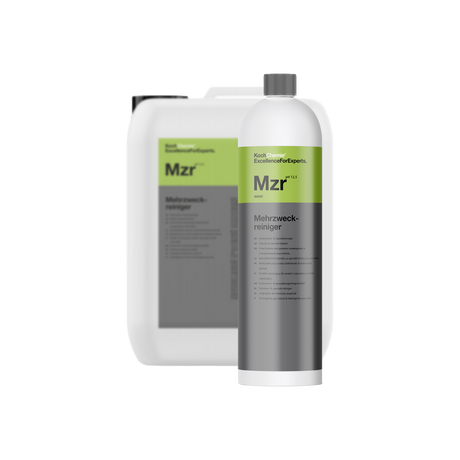
The Koch-Chemie Mehrzweckreiniger Mzr is the go-to here for a lot of detailers, with Daimler approval and a concentrate pH of 12.5. The dilution is what matters: 1:20 to 1:50 is plenty for the dashboard and door trim, and you only reach for 1:10 on badly greyed fabric upholstery or a headliner with a nicotine film. At the right dilution the alkaline solution saponifies grease that a plain cloth would only smear around.
Here too, the biggest mistake is mixing it too strong. Set the concentrate up too hot and you get white marks on dark plastic, because the alkalinity attacks the surface texture. Two passes at 1:10 give a more even result than a single one at 1:5. And the hard line stays: soft-touch steering wheels, gear knobs and pedals you leave out of it, because an alkaline cleaner leaves matt spots there.
The headliner comes with a catch: here the wet-dry vacuum is a must, not a nice-to-have. You spray the 1:10 solution on sparingly, work in short passes with a soft brush and vacuum the loosened dirt straight back out before it soaks through into the foam. A nice side effect of the Mzr is that once it's dry it smells neutral rather than chemical, which is exactly what makes the difference in a smoker's car.
The Mzr has no place on real leather or synthetic leather either. The alkalinity dries the top layer out and can cause discolouration that only a re-dye will fix. Leather, fabric and Alcantara have their own, gentler chemistry, and that's exactly what's coming in the next step.

Upholstery, Alcantara and leather need pH-neutral chemistry and the right nap direction
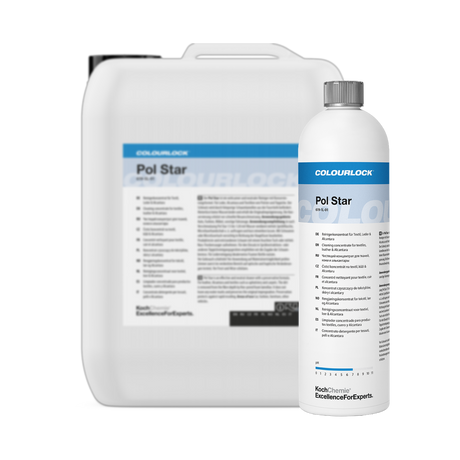
For textile, Alcantara and pigmented smooth leather, a pH-neutral cleaner is the safe call, because it lifts without attacking. The COLOURLOCK Pol Star, at pH 7, covers all three material groups from a single bottle.
The dose follows the material. 1:10 is the all-rounder for upholstery and Alcantara; on leather you stay at 1:20, because the top layer reacts to a stronger surfactant concentration with a loss of sheen. You put it on with a fine-misting trigger, not a wet cloth, because too much liquid oversaturates the weave and stretches the drying time out to as much as twelve hours. Dwell time is 30 to 60 seconds, longer gets you nothing.
With Alcantara, the nap direction decides. Wipe in circles and you visually mat down the fine pile, and the surface ends up looking duller and patchier than before. Always work in one direction, with light pressure, and finish by picking up with the dry side of the cloth in that same direction. On leather, run the colourfastness test first: hold a cotton bud with the 1:20 solution on a hidden spot for 30 seconds and check whether any colour comes off.
When you clean an interior, you usually want the smell gone too by the end, and here's the next misunderstanding. An air freshener only masks; the smell itself sits in the textile, the foam and the padding. Clean the seats and headliner thoroughly with the right cleaner and vacuum the moisture properly back out, and the source of the smell leaves with the dirt. A fresh scent is the result of clean surfaces, not of a spray that only papers over the old smell for a couple of hours.
This cleaner has an honest limit too. Open-pore leathers like aniline and nubuck, plus suede, lack the protective pigment layer, they soak the solution straight up and can bleed colour. There are specialist cleaners for those. You'll find the full range of care for delicate covers in our leather selection, and how coated leather is looked after over the long run is spelled out in full in the linked piece.
Clean first, then protect with a plastic dressing, that's the order
Clean isn't the same as protected. The dressing only goes on once the surface is dust-free and dry, and never the other way round. Lay dressing on dirty plastic and you seal the dirt in with it, and two or three days later you've got blotchy patches.
For the hard plastics inside the car, the Koch-Chemie Top Star Ts is the obvious pick, with over 45 verified reviews one of the most sought-after interior dressings in the shop. It's silicone-oil-free, leaves a satin film rather than a glossy one, and brings UV protection that keeps the dashboard from going brittle over summer. Important: don't spray it on directly, put 5 to 10 ml on an applicator sponge, work it in, let it sink in for 30 to 60 seconds and go back over it with a dry cloth.
The fact that it goes without silicone oil is more than a detail. Classic dashboard sprays with silicone travel through the air onto glass and paint, where they later mess with polishes and sealants. The satin approach has a safety upside too: a high gloss on the dashboard reflects in the windscreen when the sun's low and dazzles you. More on the difference between greasy plastic shine and real protection is in the piece Interior plastic care for your car.
If you're just getting started, combine three products: the Mzr for hard plastic and upholstery, the Pol Star for textile, Alcantara and leather, and the Top Star for protection afterwards. All three are concentrates, last over twenty interior cleans depending on dilution, and so come in well under any ready-to-use option per go. You'll find the complete range of products and tools in the interior category.
Time-wise it's manageable. A thorough interior clean with dressing runs about 30 to 45 minutes on a mid-size car, if you work in the right order and don't have to go over the same surface twice. That order, top to bottom and dry to wet, is in the end the real trick to cleaning a car interior, and no quick household remedy replaces it.

Detailing1 insight: The most expensive damage we see on customer cars outside our Showroom in Nordhorn is almost never too little cleaning, it's too much moisture in the wrong place. A soaked headliner peels at the edges because the adhesive softens, and with a wet sponge that happens in under a minute. Keep the liquid on the cloth or in a fine mist, work with distilled water instead of tap water, and give every surface five minutes to dry after cleaning before the dressing goes on. Those five minutes of patience are the difference between an interior that smells like new and one that turns musty after two days.
No time for the whole post? Get it summarized:
Add Detailing1 as a preferred source on Google