



How to apply spray wax without swirling your paint
Two questions land in our inbox again and again about spray wax, and both are about the bottle. Whether a cordless foam sprayer will handle it. Whether a spray bottle set copes with wax. Nobody has ever asked us about the microfibre towel. And that is exactly the point where a ten-minute gloss job turns into an afternoon on the polisher.
Spray wax lays gloss and beading onto the paint in minutes, and it forgives two things badly: a dry, dusty surface and a towel that is too thin. Both are decided before the first trigger pull.
Spray wax is wax and sealant in one mist
Spray wax is a water-based product that pairs natural carnauba with synthetic polymers. You mist it on, then buff it out with a microfibre towel into a thin protective film. Depending on the formula, 70 to 90 per cent of what sits in the bottle is water, plus 2.5 to 10 per cent short-chain alcohols.
Those alcohols are not filler, they set the pace. They drop the boiling point of the mix so the carrier flashes off quickly once you have spread it, and no water streaks stay behind. That is why spray wax runs on a clock: it wants spreading while it is still wet, and wiping off before it dries on its own.
Two components carry the protection. Carnauba gives you the warm, deep gloss the scene calls wet-look — a natural wax with a high refractive index that throws light back richer. Pure carnauba gives up fast under heat, so manufacturers hybridise it with amino-functional silicones. Their nitrogen groups carry a weak positive charge and pull on the negatively charged clear coat like a magnet on a paperclip. What that means for you: the film holds on the paint by itself, with no massaging in.
Some spray waxes carry silicon dioxide on top of that, the active from the ceramic corner. The proportion there is a different story: a real ceramic coating runs 70 to 90 per cent solids, a spray product 5 to 15. That is not cost-cutting, it is physics — put more solids into a water-based mist and evaporation hands you streaks instead of gloss. So a spray wax is not a cheap coating. It is its own class.
The second difference sits in the bond. A ceramic coating cross-links chemically with the clear coat and stays for years. Spray wax clings through weak electrostatic forces — it lies on top rather than anchoring in. Which means: alkaline washes and friction take it back off, and that is the deal. You trade longevity for ten minutes of work and you can top it up whenever you like.
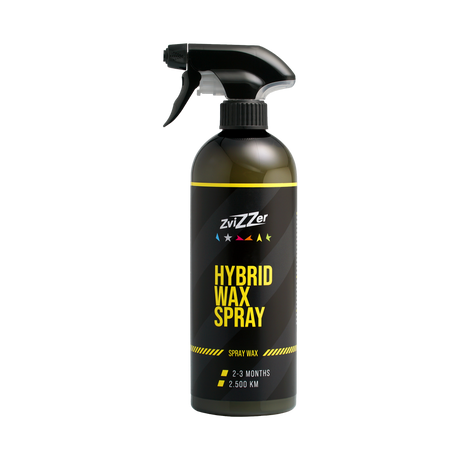
In numbers that is a contact angle of 95 to 105 degrees — anything over 90 degrees counts as hydrophobic, water stands up as beads instead of lying there as a film. A quick detailer gets to 90 to 100 degrees and, depending on the formula, holds for a few weeks up to two months. A polymer spray wax like the ZviZZer Hybrid Wax Spray 500 ml / Single holds for 8 to 12 weeks.
ZviZZer prints 2 to 3 months and 2,500 kilometres straight onto the label, and that lines up with what measurements give for this class. A hard wax sits above it optically at around 110 degrees and holds for only 4 to 8 weeks. So spray wax on your car is no step down, it is the longest-lasting finish you can lay down in ten minutes. Which class suits which driving profile, we unpicked in our guide to quick detailers.
On dry paint your towel turns into sandpaper
The most common misread is that a spray wax replaces the wash. The lubricants in the product do lay a slick film between towel and paint — that film is only 1 to 2 micrometres thick, and against what sits on a car that has been driven, it is hopelessly outgunned.
Do the maths with me. The clear coat on a current car measures 40 to 100 micrometres. That is the thickness of a hair or a Post-it note, and it holds every UV absorber keeping the colour coat underneath alive. A machine polish takes 1 to 3 micrometres off that, deeper scratches cost 4 to 8. Your clear coat is an account you can only withdraw from.
The road grime on that account is coarse. Quartz sand, brake dust and iron fallout run 5 to 10 micrometres across in town traffic. Size is not what does the damage, hardness is: quartz sits at Mohs 7, iron particles at 4 to 5, soft acrylic clear coat at 1 to 2. A 10-micrometre grain of quartz in a 2-micrometre lubricating film does not float, it stands proud. The pressure from your hand pushes it through the film into the paint, and the grain mills.
A single trapped particle at 0.5 micrometres is enough for a visible score line. Detailers on the German care forums are unanimous on this, and it matches what detailers abroad show in their videos: once the car has a normal run of miles behind it, going dry over the whole body on dark paint is no shortcut, it is a booking for the polisher. Spray wax goes on after the wash, not instead of it.

Wash cool down and think in 60 by 60 centimetres
Step one happens at the hose. The paint has to be washed and, where it is needed, decontaminated, because anything still stuck on now is what you are about to drag across the clear coat with your towel. Baked-on flies or tar will not shift with a spray wax — that is what alkaline bug removers are for, and they belong before this step.
Step two is patience. Dark paint cracks 60 °C surface temperature easily in summer, and a clear day at 24 degrees of air temperature is plenty for that, no heatwave needed. On a panel that hot the carrier flashes off in fractions of a second. The polymers get no time to line up and burn in as milky clouds and high spots. Those thermally snagged chains only come out with pressure, and pressure creates exactly the marring you were trying to avoid. So: shade, cold hand on the panel, then spray.
Shake the bottle before the first trigger pull. Wax and polymer are an emulsion, not a solution, and they separate out slowly on the shelf. Start without shaking and you lay something different on the bonnet than on the tailgate.
Then split the car up. Work a section of 60 by 60 cm at most, roughly a quarter of an average bonnet. The reason is the flash-off time from further up: mist a whole side of the car and the edges have gone tacky before your towel gets there. Thinking of a car in eight to twelve sections feels slow and ends up faster, because there is nothing to go back over.
A word on the season, because it moves the whole plan. In high summer the paint is still cool in the morning and cool again in the evening — in between sits a window where you may as well not start. If you want to detail your car in July, work before ten or after six. This is not a comfort question: between a panel at 25 °C and one at 60 °C sits the difference between a film that settles and a film that burns in.
Two pulls two towels one direction
With a highly concentrated polymer emulsion, one or two fine pulls per panel from about 30 centimetres away is all you need. More product buys neither more gloss nor more durability — it only makes the wipe-off harder and leaves smeary residue. With spray wax less genuinely is more, and that is not a platitude, it is a property of the formula.
Here comes the part nobody asks us about. Take two towels: one pulls off product and dirt, the second buffs away what is left of the haze. And the removal towel needs pile. Microfibre is measured in grams per square metre, and for spray wax 500 to 800 GSM is the ballpark. The reason is mechanical: the encapsulated dirt has to be able to travel into the weave. On a thin towel it sits up on the fibres and gets dragged across the paint as fine sandpaper.
Put a name on it: the Koch-Chemie Polish and Sealing Towel 520GSM lands at 520 GSM, right inside that window, and does the removal pass. The short-pile ZviZZer Microfiber Cloth “Edgeless” (300 GSM) is the right call for the finish pass, where there is no dirt left to carry, only haze. Do both jobs with the thin towel and you save a towel and pay in swirls.
The motion itself is unspectacular, which is exactly why it matters: pull straight, never circle, no pressure. The lubricant does the work, your hand only steers. Fold the towel once and you have four clean sides, and take a fresh one for every pass. A towel that was on the sill a minute ago carries silicate particles — on the bonnet those turn into scratches you only spot when the sun is low.
Then leave it alone. The film needs about an hour before the beading is fully there, it is water-resistant after 4 hours and fully cross-linked after 24 hours. The panel will feel slick after a minute — that is the lubricant, not the protection. Test it with the garden hose after ten minutes and you measure nothing except your own impatience.

The three mistakes that cost you the gloss straight away
The costliest mistake is the sun, and it is also the most common. Spray wax on a hot panel flashes off before it can settle. What you get is clouds and high spots that stay put under raking light. Try to buff them out with pressure and you trade streaks for micro-scratches.
Mistake two is the quantity. The “more is more” principle comes from a different product category. A layer that is too thick builds no second protective film, it leaves smearing and costs you double the wiping. Mistake three is the one towel for the whole car, the cross-contamination described further up.
And then there is a mistake that looks like product failure. Lay a carnauba-based spray wax over a fresh ceramic coating and you measurably make your beading worse. A good coating reaches contact angles up to 115 degrees; the wax on top can physically only manage its 95 to 105. The ceramic disappears under the wax and the car suddenly beads worse than before. The coating's UV protection and scratch resistance stay untouched by this — the look does not. If you run a coating, reach for a chemically matched maintenance product rather than just any wax.
Worth being straight about what a spray wax fundamentally cannot do, too. It corrects nothing. Swirls, holograms and scratches stay visible, because a sprayed film fills minimally and removes no defects. If swirl marks show up under raking light, a polish belongs before and the spray wax after, not the other way round.
What it genuinely does deliver in summer gets underrated. Bug splatter carries proteins and amino acids that eat into the clear coat under UV and heat. Sealed paint gives them nothing to bite into: they stick to the polymer layer instead of the paint and come off the next day rather than sitting there baked in. A spray wax will not dissolve flies that have already gone rock hard, that needs an alkaline bug remover. It buys you time, not miracles.
Your starter setup for the summer
To get going you need three things, not thirty: a spray wax, a long-pile removal towel and a short-pile finish towel. That is the whole list.
The ZviZZer Hybrid Wax Spray 500 ml / Single is a good starting point for that, because it takes the hybrid route: carnauba for the gloss, polymer for the 8 to 12 weeks. At one or two pulls per panel, 500 millilitres carries you through a lot of sessions — this is no consumable you re-order monthly. It is cleared for paint, plastic and glass, which saves you masking off trim. The film is water-resistant after 4 hours and fully cured after 24 hours: work in the evening with rain due overnight and you plan around that.
Different goal, different product. If you only want to pull dust and fresh fingerprints off after the wash and make drying easier, the ZviZZer Quick Shine Quick Detailer 500 ml / Single is enough — its label says 1 to 2 months or 1,500 kilometres, so barely half of the spray wax from the same house, and quicker to get through.
If you are after maximum depth and durability and you will put the time in, a hand-applied hard wax like the ZviZZer Wax “Synthetic” 100 ml / Single is the more honest call. Spray wax on your car is the middle ground between the two, and it is good at being the middle ground.
The moment this all pays off, by the way, is not the dry application, it is the wash. Hit the still-wet bodywork with the spray wax right after the rinse: the polymers break the water film open immediately, the water sheets off instead of standing, and the rest comes away with almost no friction. You skip the pass over dry paint entirely — and the limescale rings from the next summer downpour crystallise on the polymer film instead of in the clear coat.

Detailing1 insight: What we see day-to-day: the questions about spray wax are nearly all about the container — whether the spray bottle copes with wax, whether the cordless foam sprayer will handle it; “spray bottle” is a fixture in our shop search too. Nobody asks us about the towel. And between a 300 and a 520 towel sit 220 grams per square metre, and those decide whether the quartz sand vanishes into the pile or lands on your clear coat. Straight up: on our own Hybrid Wax Spray product page the 300 Edgeless is listed as an accessory — right as a finish towel, too thin as a removal towel. If you only buy one towel, buy the thicker one.
No time for the whole post? Get it summarized:
Add Detailing1 as a preferred source on Google