



Thick foam is made inside the lance, not on the paint
One question keeps landing in our inbox, roughly like this: what is the right dilution? The honest answer is awkward, because it isn't printed on the bottle. The same mix in the container gives you two completely different concentrations on the panel depending on whether you run a small cordless washer or a big Kränzle. That is why one setup foams beautifully and the other just runs soapy water down the door.
A foam lance dilutes your concentrate a second time, with the water flow of your pressure washer. Measure that once and you dose repeatably instead of guessing. The rest is orifice, water and dwell time.
From Thursday you get six dry days in a row
Thursday through Tuesday stays dry, and Saturday hits 27 degrees with almost 15 hours of sun. If you want to wash at the weekend, you have both time and daylight.
Today is the day to check the setup, not the car. Showers are still moving through on Wednesday, and a shower on dusty paint is about the nastiest combination summer hands you: the rain binds dust, pollen and industrial fallout and dries as a crust. That crust is exactly what you will be trying to break down on Saturday, and that is what a pre-wash is for.
August also serves up the toughest dirt mix of the year. Bug splatter, tree sap and traffic film sit on warm panels and bond with the dust from the dry spell into a layer no wash mitt gets off politely. At the same time the window narrows: pre-wash chemistry wants to work between 5 and 35 degrees, and at the top end every minute of dwell time counts double. A dry Saturday at 27 degrees is a friendlier slot than a Sunday at 33.
Interest in the topic is measurably climbing. Search demand for the term foam cannon sits about 24 per cent above its twelve-month average over the last eight weeks, while snow foam is flattening out. People are no longer shopping for the chemical, they are shopping for the kit. That matches what lands in our inbox: questions about dosing, about the container, about the spray pattern.
One note for Sunday, because it stands out in the forecast at 33 degrees. In that heat you work early in the morning or in the shade, otherwise everything flashes off on the paint before it can do anything. At 27 degrees Saturday is the calmer of the two.
Watery foam means grit under your wash mitt
The pre-wash is not a show effect, it is the step that decides whether you get swirls. Its job is to cut the particle load before textile ever touches the paint.
The mechanism is unspectacular and effective for exactly that reason. Surfactants drop the surface tension of the water, wrap greasy traffic film into micelles and hold it in suspension. As the bubbles collapse on the panel they set off microscopic currents that loosen the dirt underneath through capillary action. Whatever runs off then takes loose particles with it. What that means for you: what leaves in the foam can never end up between your wash mitt and the clear coat.
The fact that foam clings at all is formulation, not air. Good snow foams run three surfactant classes side by side. Sulfates deliver the fast, high foam volume but are unstable on their own. Betaines act as foam stabilisers, firm up the bubble walls and create what the scene calls cling. Alkyl polyglucosides are electrically neutral, shrug off hard water and do the actual work on oily traffic film. Judge a foam by height alone and you miss half of it.
Foam that is too thick actually works worse than foam that is a bit wetter. Shaving-cream consistency is mostly air, it puts almost no cleaning substance in contact with the surface and drops off as a block after a couple of minutes. What you want is a blanket that creeps down slowly over four to eight minutes and keeps carrying dirt with it. After five minutes you should still have around 30 per cent of the original foam height on vertical panels.
So watery foam is not a cosmetic issue. It has no cling, so no contact time, so no dissolving power. The particles stay exactly where they are. Go over them with a mitt and you grind them into the clear coat. How to run that next step cleanly is in our piece on washing a car without swirls.

The orifice decides before the concentrate does
A high-pressure foam lance runs on the Venturi principle. The water jet is forced through a tiny orifice, speeds up there, and the drop in pressure pulls concentrate out of the container.
That orifice is the part almost nobody touches. Its diameter has to match the flow rate of your machine, not your wishful thinking. A 1.1 mm orifice belongs on compact machines running roughly 4.5 to 6.5 litres per minute below 110 to 130 bar. The smaller opening builds a little back pressure, raises flow speed and is what creates the vacuum that does the drawing in the first place.
The factory standard on many lances is 1.25 mm, designed for 6.5 to 8.0 litres per minute at 130 to 160 bar. Hang that on a weaker machine and the water moves through too slowly, the vacuum is not strong enough, and too little concentrate reaches the mixing chamber. That is the watery foam people complain about in forums. The reverse holds too: above 8 litres per minute you need a bigger opening or the pump backs up. Which number actually counts on your machine, we took apart in litres instead of bar.
After the orifice comes the second underrated part. In the mixing chamber the mix meets air fed through the dial on top, then gets forced through a fine stainless mesh. Only the turbulence in that mesh shears the liquid into microbubbles. The density and cling of your foam are made in the mesh, not in the bottle. A blocked mesh turns good concentrate into a disappointing result every single time.
A garden hose plays by different physics. Three to five bar of static pressure is enough to draw shampoo in, but nowhere near enough to foam it. What comes out is a soapy film that runs straight off. If you have no pressure washer, a pump foamer beats a hose gun, because it gets to foam a different way.
Measure once what actually lands on the panel
The number that matters is called Panel Impact Ratio, and it describes how much neat chemistry ends up on the paint. It is not the same as what you pour into the container.
The reason is the hardware. A pump foamer sprays the solution at exactly the strength you mixed, because it adds no further water. It runs on air pressure rather than suction, and you set foam density with the felt discs inside. A high-pressure lance keeps mixing your container blend with water from the pressure washer. How far it dilutes depends on flow rate and lance, and that varies wildly between two setups.
Measuring takes five minutes and holds from then on. Put exactly 1,000 millilitres of plain water in the lance container, set the dial to maximum concentrate feed and spray the container empty into a bucket with a scale on the running machine. If ten litres come out, your setup dilutes one to nine. For a target of four per cent you multiply ten litres by 0.04 and fill 400 millilitres of concentrate plus 600 millilitres of water into the container.
Without that measurement, any figure like a hundred millilitres in nine hundred is pure guesswork. A big machine at eleven litres per minute empties the container fast and dilutes heavily, a small cordless one at four litres per minute barely dilutes at all. The same container blend gives you two completely different results on the paint, and on the weak machine it lands on the overdosed side.
That leaves the question of wet or dry paint. Foam clings better to a dry panel and does not get watered down by a film of water, which makes it the stronger option on normal summer dust. If there is coarse grit or winter slurry on the car, rinse it off with plain water first, otherwise the foam drags the grains across the clear coat as it runs. Then let it dwell four to eight minutes, no longer.

Three concentrates and one tool for your setup
What goes in the lance comes down to your paint protection. The pH value is the number that decides compatibility and cleaning power at the same time.
The Koch-Chemie Gentle Snow Foam „Gsf" 1000 ml / 1 Liter sits at around pH 7.5, which makes it the default for weekly upkeep on protected cars. Our house dose is 20 millilitres per litre of water in the container, roughly one to fifty, and it gives four to six minutes of cling on vertical panels. A one-litre bottle covers about fifty pre-washes that way. Twelve verified Trusted Shops reviews back up how gently it treats freshly sealed paint.
If you want more cleaning power without giving up your sealant, the Koch-Chemie Ultra Foam „Uf" 1000 ml / 1 Liter is the one. At pH 8.5 it sits between the pH-neutral Gsf and the alkaline Active Foam at pH 9.5. You pull it to a maximum of one per cent in the lance, consumption runs three to eight millilitres per car, and by hand a dilution down to one to three hundred is plenty. One pH step means ten times fewer hydroxide ions, and a polymer sealant notices that over the months.
Picking between them is easier than the shelf makes it look. Running a carnauba wax or a fresh spray sealant, stay with the pH-neutral foam, because any alkalinity eats into that sacrificial layer. Running a ceramic coating and annoyed that the beading has gone lazy, the mildly alkaline foam is the better call, because it clears traffic film out of the pores without attacking the cross-linked silicon oxide. And on an unprotected daily, it simply comes down to how much bug splatter is sitting on the front end.
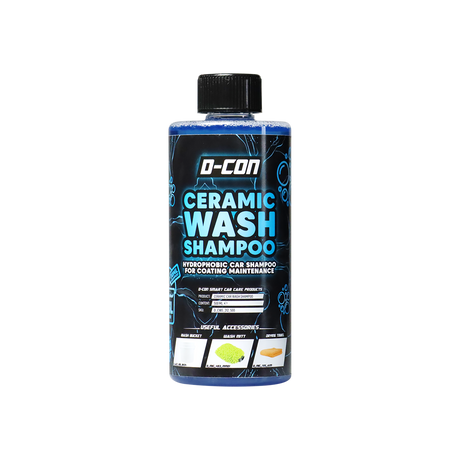
As a mild alternative with a mango scent there is the D-CON Snow-Foam-Concentrate 500 ml, made for foam lances and foam guns. And if you work without a pressure washer or wash at a jet-wash bay, grab the iK Sprayers „iK Foam" Pro 2 Pumpschaumsprüher 1.25 Liter. It runs on air pressure rather than Venturi, the safety valve opens at 3 bar, and three foam settings come off the coloured caps. The full range sits in Snow Foam and Schaumsprüher.
Flash-off and lime soap are what kill your foam
Three mistakes cost more foam quality than any product choice: too much concentrate, paint that is too warm, and kit that never gets flushed. All three are free to avoid.
Past a certain point, more concentrate buys you nothing. Above the critical micelle concentration there is no extra cleaning power to be had, the foam just gets heavier and slides off as a block without dwelling. A normal maintenance wash needs 20 to 30 millilitres of concentrate per car, a dense pre-wash puts you at 500 to 800 millilitres of ready-mixed solution. Everything beyond that is money running down the drive.
Water is worth a second look. Mixing water at 30 to 40 degrees drops the viscosity of the concentrate and wakes the surfactants up faster. Hard water pulls the other way: from about 14 degrees of German hardness, calcium and magnesium react with anionic surfactants to form insoluble lime soaps, and the foam volume collapses. For the Gsf, Koch-Chemie still recommends dosing down in hard water, because otherwise you get residue. So if your foam falls flat, distilled mixing water is the better lever than another capful of concentrate.
Leaving it on too long costs more than it gives. Past ten minutes the carrier water evaporates, the surfactant concentration spikes exactly where the film is thinnest, and you are left with water spots on the paint, milky patches on anodised trim and mineral haze on glass. In direct sun the same thing happens in half the time. Working panel by panel is not perfectionism, it is your insurance against a second wash the same day.
And then the classic that reaches us as a warranty claim. The fine stainless filter inside the lance clogs with surfactant residue and lime, after which it splutters and stops foaming. Pump foamers get it in the felt discs. Direction matters too: foam from the bottom up, rinse from the top down, never in the sun and never let it dry, because dried surfactants leave streaks that cost you a second wash.

Jasper's tip from the shop: The most common fault that reaches us as a warranty claim is not a fault at all. A lance or pump foamer stops foaming after a few weeks because plain water never ran through it after use. I unscrew the container and let the empty lance run clear water for 30 to 60 seconds, and I half-fill the pump foamer and pump it dry once. If you have left it too late, warm water with a bit of citric acid overnight lifts the lime out of the mesh. And gloves and eye protection belong on while you mix, because the concentrate carries H318 and causes serious eye damage.
No time for the whole post? Get it summarized: