



A leather brush is not a default tool, it is a special case
If you want to clean leather seats, the cleaner is what you think about first. The question that reaches us nearly every week sounds just as harmless: is this cleaner safe on perforated leather? Usually the cleaner is fine. What comes after it is not — the brush. Pull one across a seat bolster and you are working on a clear coat thinner than a single hair. And that matte, finally-clean look is sometimes the exact opposite.
Car leather is a layered system with a clear coat of five to twenty micrometres. A brush pulls dirt out of the grain, and it costs clear coat while doing it. This guide shows which bristle hardness belongs on which leather, and when you are better off not brushing at all.
What you are actually touching when you brush
Car leather is almost always a coated layer system rather than an open hide, and the top layer decides what a brush does to it. Three coats sit on the tanned hide: a primer of five to fifteen micrometres, a pigment coat of ten to thirty-five micrometres, and on top a transparent clear coat of polyurethane or acrylic measuring five to twenty micrometres.
That last number is the reason this article exists. A human hair is about seventy micrometres across, a sheet of copier paper roughly a hundred. So the only real protection on your seat is about a tenth of a hair thick. And for a material to be called leather at all, the whole finish may not exceed a hundred and fifty micrometres — the headroom is capped by law.
Semi-aniline leathers, the kind you find in a lot of sports cars and premium interiors, are tighter still. The pigmentation there is deliberately fine and translucent so the grain stays natural. The whole top layer then adds up to five to forty micrometres. The leathers that look best have the least reserve.
The brush still has its place when you want to clean leather seats. Most pigmented smooth leathers carry an embossed, artificial grain, pressed in under heat and pressure. Over the years, skin oils, sweat residue, textile fibres and fine mineral dust collect in the microscopic valleys of that grain. A flat microfibre towel rides over those valleys without reaching them — it cannot beat the capillary action. The brush is the only tool that gets the dirt out of there mechanically.
Green, yellow, red: what bristle hardness does to leather
Bristle hardness decides how much force lands on a single bristle tip, and with it the difference between clean grain and a clear coat rubbed matte. The stiffer the fibre, the more the shear load concentrates on one point — with exactly the same hand movement.
Three bristle materials run in the detailing trade. Horsehair from mane or tail has a scaled keratin surface, holds moisture well and spreads the load wide; the industry treats it as the safest material. Length steers stiffness too: fifteen millimetres is noticeably stiffer and good for dry-sweeping seams, twenty-two millimetres is the practical compromise, thirty millimetres is extremely soft.
PBT, a thermoplastic polyester fibre, barely takes on water and is far less abrasive than nylon because the tips bend away sooner. Nylon has the best recovery and therefore the highest point load — it belongs on tyres, rubber and tough textiles, not on leather. Once you have that in your head, it is obvious why a wheel brush has no business inside the cabin.
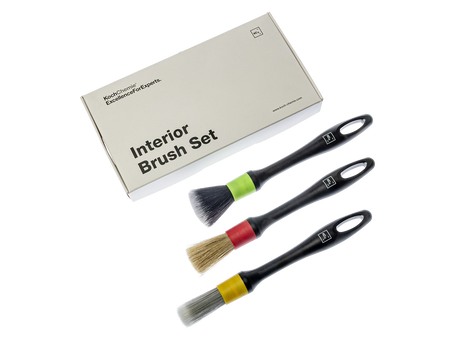
In practice you do not need to run that material check every time. The Koch-Chemie Interior Brush Set codes hardness by colour. The green one has the finest bristles and a narrow tapered head — it is the only one in the set we let anywhere near leather. The yellow one is medium and belongs on vents and shifter surrounds. The red one is the hard one, made for door sills and pedals.
That the green brush pulls the best ratings of the three here fits the picture — it is the one you do not regret on a delicate surface. And bristle colour tells you nothing about the material: the red brush carries the natural-bristle look and is still the hardest of the three. Grab by looks instead of by colour code and you grab wrong.

Even the softest brush is not free
The uncomfortable news first: in controlled tests from the German detailing scene, every brush tried left visible micro-scratches in the clear coat after twenty passes — from its own weight alone, with no hand pressure at all.
The test ran on acrylic sheets coated with real leather clear coat. The result was the same regardless of bristle material: PBT, nylon and even expensive horsehair produced hazing and fine scratches. The myth of the completely safe leather brush is done. The brush is not bad — the expectation was wrong.
The factory standards explain why that does not contradict OEM quality. Car leather has to survive three hundred to a thousand rub cycles wet-on-wet in the Veslic rub-fastness test to DIN EN ISO 11640, rated on the grey scale ISO 105-A02 and A03. A leather sofa only has to take fifty to two hundred cycles in the same test, so seat leather sits a factor of two to twenty above it. Works standards like Daimler DBL 5399, VW TL 52064 and BMW GS 97034-6 spell it out, with the abrasion test running to VDA 230-211 at a defined nine to twelve kilopascals.
Only that applies to standardised wool felt under calibrated stamp pressure. A brush is a different animal: hard single tips, uncontrolled hand pressure, plus cleaning chemistry. Under those conditions the rub-fastness limit can be crossed after ten to twenty manual passes. So the limit is five to a maximum of ten light strokes per area, pressure from the brush's own weight only. The moment you notice you are pressing, you have the wrong tool in your hand.
Chemistry instead of mechanics: let the foam do the work
Every pass the chemistry takes on is a pass the brush does not have to make — which is why the pH of your cleaner, not bristle hardness, decides how gentle a leather clean really turns out.
After tanning and neutralising, leather is a mildly acidic medium at pH 3.5 to 5.0. That acid mantle keeps the hide flexible and the polyurethane layer stable. COLOURLOCK "Leather Cleaner" (Mild) sits at pH 5.5, almost exactly on that value, and works with under five per cent anionic surfactants. It is the cleaner for regular upkeep — and the reason a few strokes are usually all you need when you clean often.
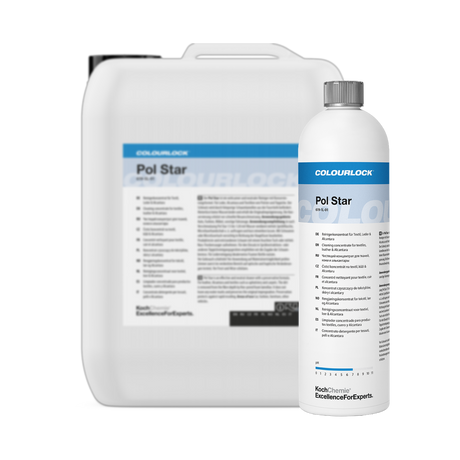
The strong version of the same system goes to pH 8.0 and runs fifteen to thirty per cent anionic surfactants plus potassium oleate. That is three to six times the surfactant load, meant for baked-in grease on long-neglected bolsters, not for every Saturday. COLOURLOCK "Pol Star" cleaning concentrate sits in the middle at pH 7 and covers textile, Alcantara and pigmented smooth leather from one bottle.
What you want to keep away from leather are alkaline all-purpose cleaners at pH 9.5 to over 11. Under moisture and brush mechanics they break the polymer chains of the clear coat apart. What you get is a dull, ultra-matte surface — and this is where the most expensive misreading in leather care happens: a lot of people read that matte as finally properly clean. It is a dissolved clear coat that will flake at the next clean and expose the colour layer. Once colour shows up on the microfibre, the top layer is already through.
The second half of the chemistry is how you put it on. Cleaner does not go onto leather as a liquid, it goes on as foam — for us through the Koch-Chemie Foamer Bottle, two or three pumps onto a sponge or brush, never straight onto the seat. Liquid cleaner runs into seams, perforation holes and micro-cracks, soaks the hide and lets it shrink as it dries.
Foam instead stands on the grain, stretches the contact time and acts as a microscopic lubricant between bristle and clear coat. A soaked polyurethane film swells and loses its abrasion resistance within milliseconds — brushing it wet is doubly harmful. And the foam may dissolve, but it must never dry on: once it does, the loosened dirt goes back into the leather and you start over.

Perforated, aniline, Alcantara: this is where the brush stays down
Three material groups do not take a brush, and they often sit in the same seat as the tough pigmented leather.
On perforated leather, the answer to the question at the top is: no brush at all. Bristles fray the hole edges and push cleaner into the perforation, where it runs into the foam core of the seat heater and never dries out again. On perforated areas you work with a sponge or a cotton applicator, barely damp, and take it off quickly.
Aniline and nubuck leathers have no top layer, or a wafer-thin one, and pull dirt straight into the fibre. Here it is not just the brush that is wrong but the standard cleaner too: for open-pore leathers the leather cleaner category holds a dedicated cleaner with under five per cent anionic surfactants and saponified sulphochlorinated paraffin oils that stabilise the fibre structure instead of stripping it. Pol Star concentrate is explicitly not cleared for those leather types, and it says so on the bottle.
Alcantara is not leather at all but a microfibre non-woven of roughly sixty-eight per cent polyester and thirty-two per cent polyurethane. The velvety feel comes from the web being sliced through the middle in production so that millions of fibre tips stand up. Press that pile flat with a hard brush and the tips mat together or snap, and the material reflects directionally from then on — that is the shiny patch effect, and it is mechanical, not chemical.
So on Alcantara the brush may only work dry or barely damp, and then to lift the pile, never to scrub. Circular movements are out here, you work along the fibre direction. And a side note: steam cleaners are risky on leather and on Alcantara alike, because too much moisture can separate the built-up layers. How to get the pile clean without ruining it is covered in detail in our piece on cleaning Alcantara properly.
Which brush and which cleaner suit your leather
If you want to clean leather seats, the choice of brush and cleaner always runs through two questions: how is the leather finished, and how stuck-on is the dirt. Everything else — hardness, pH, number of strokes — follows from those.
If you have pigmented smooth leather with a pronounced grain and you are dealing with normal daily dirt, Leather Cleaner Mild plus the green brush with five to ten light strokes is the right pairing. If that same leather has gone unloved for a long time and the bolsters or the steering wheel look greasy, take the strong version — but with a sponge instead of a brush, because the stronger chemistry already replaces the mechanics. If you have textile, Alcantara and leather in one interior and want one bottle on the shelf, Pol Star is the economical answer: 1:20 on leather, 1:10 on fabric and Alcantara, 1:5 on carpet and footwells.
It pays to be precise when you mix. For a 500 millilitre spray bottle at 1:10 that is forty-five millilitres of concentrate to four hundred and fifty-five millilitres of distilled water. Distilled, not tap: lime leaves white rings once it dries, and on dark Alcantara you see it immediately. The working solution keeps for about seven days, after which the surfactants fade. Dwell thirty to sixty seconds, then take it off along the fibre direction.
In the end the order beats any cleaner. Step one is always dry: vacuum thoroughly, sweep seams and folds out with a short, stiffer brush. Quartz sand left in a seam works like sandpaper under a wet brush.
Then work area by area, seam to seam, not in spots. A single squirt penetrates the substrate, and as it dries the capillary action carries loosened dirt to the edge of the wet patch. What stays behind are sharply defined dark water rings that are hard to correct. Reckon on fifteen to thirty millilitres of cleaner and ten to fifteen minutes for a heavily used front seat.
And then there is temperature, which has a say this week. Nordhorn is sitting at just under twenty-seven degrees under a clear sky today, and the continuous work window opens on Saturday. A closed car in the sun easily hits forty to fifty degrees inside, and the clear coat is thermoplastic: at those temperatures it softens, and mechanical friction deforms it plastically instead of just cleaning it.
The finish gets smeared and roughened, and that does not polish back out. So work between fifteen and twenty-five degrees, in the shade or early in the morning. And use the two days until Saturday to vacuum the seat, pick the right brush from brushes and detailing brushes and mix your working solution.
After the clean, the part that makes the next one easier is still missing. COLOURLOCK "Leather Care" smooth leather milk lays a breathable care film with UV protection on the surface and drops the friction for the next round. Keep the friction coefficient down and you need fewer passes next time — and passes are the currency leather care is counted in.

Detailing1's tip from the shop: The damage pattern that lands in our inbox most often is shiny islands on the seat cushion — light, greasy-looking patches in the middle of matte leather. The cause is almost never the cleaner, it is uneven dosing: two pumps on one half of the cushion, five on the other, and the wetter spot picks up more mechanics on the wipe. Our fix is a strip of masking tape across the cushion as a working boundary — finish the left, move the tape, finish the right, always two pumps per half. Plus one single test on the lower bolster before you start up top: if colour comes off onto the towel there, the brush is out of the game and the seat is a restoration job, not a cleaning job.
No time for the whole post? Get it summarized: