



Pollen on your paint — Why waiting is a mistake
Know the feeling? You washed your car over the weekend, and two days later there’s a fine yellow-green film on everything — the hood, the roof, the windows. Pollen. Looks harmless, right? Most people think: “It’ll just come back anyway, I’ll wash it next week.” That is exactly the mistake. Because pollen isn't just dust — it contains enzymes that can chemically attack your clear coat in less than 48 hours. In this article, I’ll explain why this happens and what you can do about it without panicking.
What pollen does to your clear coat — and why 48 hours is the limit

To understand why pollen is so problematic, it helps to look at its biology. Every pollen grain is surrounded by a protective shell that bursts upon contact with moisture. This could be dew, light rain, or simply the humidity of a warm night. When this shell breaks open, enzymes and organic acids are released — and these are exactly what attack the top layer of your paint, the so-called clear coat.
The clear coat is the transparent protective layer over the base coat. It is thin — usually between 30 and 50 micrometers — and it is the first line of defense against UV radiation, dirt, and chemical influences. When pollen enzymes act on this clear coat, a type of chemical etching occurs. Professionals call this “pollen etching.” The result is dull, slightly sunken spots in the paint that become visible as irregular blemishes in direct sunlight.
The insidious thing is: the reaction requires two triggers — moisture and heat. On a cool, dry day, little happens. But as soon as temperatures rise above 15°C (59°F) and the pollen becomes damp, the process begins. Direct sunlight accelerates everything further. The critical window is about 24 to 48 hours. After that, the damage can be so deep that a normal wash is no longer enough and you will need to polish.
How to remove pollen properly — without damaging the paint

The good news: if you react quickly enough, pollen is no problem. The bad news: “just wiping it off quickly” is exactly the wrong approach. Besides enzymes, pollen also contains fine particles that act like sandpaper when wiped dry. Anyone who runs a dry cloth over pollen-covered paint risks micro-scratches — so-called swirls that are only visible in direct sunlight and make the paint look dull.
The right way always starts with a thorough pre-wash. This means: first rinse off the heavy layer with a high-pressure cleaner or garden hose, then apply a pre-wash solution and let it dwell. A product like INNOVACAR SP1 Prewash is ideal for this — it chemically dissolves organic contaminants like pollen before anything touches the paint mechanically. A dwell time of three to five minutes is usually sufficient.

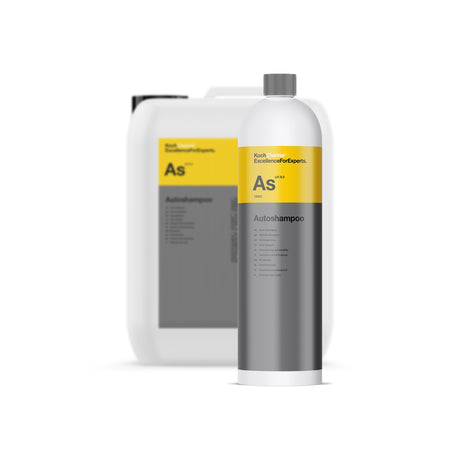
Only after that comes the actual contact wash with a wash mitt and a good car shampoo. Here, I recommend Koch-Chemie Autoshampoo As — it has high cleaning power while remaining gentle on existing sealants or coatings. Always work from top to bottom, rinse the mitt regularly, and use the two-bucket method if you want to do it right: one bucket with shampoo solution, one bucket with clean water for rinsing the mitt.
After washing, dry the car thoroughly — preferably with a clean microfiber towel or a car dryer. Do not let it air dry, because water spots from limescale are the next cosmetic problem you want to avoid.
Between washes: How to quickly neutralize pollen buildup

Not everyone has the time to wash their car completely every other day. And you don't have to. For the days between washes, there is a clever helper: the Quick Detailer. The INNOVACAR W1 Quick Detailer can be applied in just a few minutes — spray on, wipe off with a clean microfiber towel, done. It binds the pollen dust, prevents it from being smeared across the paint, and leaves behind a light protective layer.
Important: The Quick Detailer is no replacement for a full wash. It is an intermediate solution for light to medium pollen buildup. If the buildup has already become damp and dried on, there is no way around a proper pre-wash. But for the daily yellow haze on the hood, the Quick Detailer is the remedy of choice — fast, gentle, and effective.
Typical mistakes you should avoid
The most common mistake I see in practice is ignorance. Many think: “Pollen is soft, it can’t hurt the paint.” This is true for the particles themselves — but not for the enzymes they release. The second classic mistake is the car wash with brushes. They press the pollen dust into the paint with force instead of dissolving it. If you use a car wash, only use a self-service bay with a high-pressure pre-wash.
A third mistake concerns drivers with allergies: those who avoid the car for health reasons and put off washing it risk paint damage that adds up. My advice: if you can’t wash it yourself due to allergies, ask someone else or use a detailing service. Better to have it professionally washed once a week than to let the pollen do its work for four weeks.
Daniel's Tip: The best protection against pollen etching is an intact sealant or a ceramic coating. The protective layer prevents the enzymes from reaching the clear coat directly. If you have sealed your car in the fall or spring, you will notice that the pollen comes off much more easily — often a quick rinse with the garden hose is enough. If you don't have a coating yet: spring is a good time to catch up, as long as temperatures are between 10 and 25 °C.
Conclusion: Act fast, wash properly, protect your paint

Pollen looks harmless, but it is one of the underestimated enemies of your car paint — especially in spring, when birch and ash trees bloom at the same time. The most important rule: Do not wait. Wash within 48 hours after heavy pollen flight, always start with a pre-wash, and never wipe dry. And if you want peace of mind in the long run, invest in a good sealant.
Everything you need for a safe pollen wash — from pre-wash to Quick Detailer — can be found in our Car Care section. And if you have any questions, just write to us in the chat.
No time for the whole post? Get it summarized:
Add Detailing1 as a preferred source on Google