



Reviving a tired coating in May with the Reactivation Shampoo
You wash your car in May, push the hose across the hood, and see no beading anymore. The water runs off as a flat film instead of rolling away in drops. The first thought: the coating is dead. In most cases it isn't. There's just a layer of limescale, salt residue and pollen enzymes sitting over the sealant film that you can't see right now.
The Koch-Chemie Reactivation Shampoo Rs is an acidic care shampoo that dissolves mineral deposits and reactivates the hydrophobic properties of an existing ceramic coating in a single rinse cycle. Schedule two to three applications in May and you'll extend the sealant's lifetime by months.
May weather puts your coating through an honest test
In May your coating runs through its hardest stress test of the year. UV radiation rises, pollen sticks to the paint with enzymes, and the first warm rain rinses winter road-salt residues back onto the bodywork. These three loads stack on top of each other and push the beading effect down without actually destroying the underlying SiO₂ bond.
The water-droplet test is the simplest diagnostic. Spray your clean hood with plain water and watch how the droplets react. With an intact coating, round beads form with a contact angle above 90 degrees and roll off the surface densely. If the water instead stands flat as a film and runs off slowly, a mineral barrier layer is sitting over your coating. That's May reality, not the end of the coating.
This mineral barrier comes from calcium carbonate from hard tap water, sodium chloride from winter road-salt service, and plant pollen whose enzymes dry into the clear coat in 24 to 48 hours under sunlight. The human eye sees a glossy surface, the water notices every deposit. Translation for you: what sits under the greasy pollen film often still has six to twelve months of lifetime left.
May provides the ideal weather window for this. This morning in Nordhorn, 17 degrees Celsius, overcast cloud cover with light rain from noon onwards. With this weather, no foam dries on the paint, the rinse water runs off evenly and the SiO₂ components get the time they need to rebond. With full sun at 28 degrees you wouldn't have a chance to run the reactivation cleanly.

When water no longer beads, limescale is usually the cause
The most common misdiagnosis in May reads: the coating is worn out, I need a new sealant. In fact, the bond of the SiO₂ polymers in the clear coat is surprisingly robust. What blocks it are surface deposits with a different chemical profile from the sealant itself.
Calcium carbonate is the main culprit. It forms everywhere drip water dries on paint: on the rear spoiler after the pressure washer, on the hood after morning dew, on the door frames after rain. Calcium carbonate is alkaline and lays itself as a microfine film over the hydrophobic SiO₂ layer. Water can no longer bead on it because the surface now reads as alkaline rather than silicate.
Road salt from winter additionally sits in the hard-to-reach areas. Even after ten washes you find chloride crystals in the door folds, on the tailgate beads, and under the mirror caps. With the first warm May rain these residues dissolve, run across painted surfaces and leave an electrolytic deposit that further dampens the hydrophobicity. In daily life you notice it because your car looks dirty again faster after each wash.
Pollen enzymes work differently. Birch, oak and grasses release proteases that, combined with heat and UV, penetrate the clear coat. On unprotected paint they etch in within 24 to 48 hours. On a coated paint the enzymes don't slip in quite as deep, but they leave a sticky, matting pollen film that a normal pH-neutral shampoo won't break down. That's not the death of the sealant, it's reversible soiling.

The acidic care shampoo dissolves mineral deposits
The Reactivation Shampoo Rs works in the acidic range, which isn't shown prominently on the label but is the decisive lever. An acidic surfactant formulation neutralises calcium carbonate deposits and lifts them off the clear coat together with salt residues and pollen proteins. That's chemical cleaning instead of mechanical friction, with the goal of exposing the underlying SiO₂ sealant.
The reactivation happens in two steps. First the acidic components dissolve the mineral layer, then the surfactant component helps to carry it off evenly during the rinse cycle. What remains is the original sealant film, which now has direct contact with water again. Translation for you: the beading effect doesn't come back from the shampoo itself, but from the exposed sealant underneath.
This is what fundamentally separates the Koch-Chemie Reactivation Shampoo Rs from a care shampoo like the Ceramic Effect Shampoo Ces. The Ces adds a fresh SiO₂ care layer with every wash and builds hydrophobicity additively. The Rs instead removes what blocks the old hydrophobicity. Both relate to sealants, but they work in opposite directions.
In practice you notice the difference in scent and foam pattern. The Rs foams strongly but has a clearly reduced care component. The foam pattern is denser and stands longer than with a classic wash shampoo, which extends the dwell time per section. A one-litre bottle lasts for around 15 to 20 washes depending on dilution, which in May coating-maintenance mode with two to three applications a month is solid.
Reactivation Shampoo Rs, two buckets, one rinse
The workflow for reactivation follows the standard two-bucket method, with two important adjustments for the shampoo's acidic profile. Wash bucket with 40 to 50 millilitres of Rs in 10 litres of lukewarm water, separate rinse bucket with clear water, and a high-pile microfibre wash mitt like the Oktopus set.
Pre-rinsing is always done, with the Rs that isn't a recommendation, it's a condition. Anyone who uses a Gentle Snow Foam Gsf as a pH-neutral pre-cleaner has already removed the coarse dirt before the actual reactivation wash. This prevents the wash mitt fibres from dragging sand particles across the clear coat while the Rs is working on the mineral layer. Going straight into the acidic wash without a pre-rinse risks wash marks on the surface that has just been reactivated.
Work section by section, from top to bottom. Roof, hood, windows, doors, rear, then rocker panels. Each section is applied, allowed to dwell for one minute and rinsed off immediately. The Rs needs this dwell time to soften the calcium carbonate deposits, but must not dry on the surface under any circumstances. At 17 degrees and overcast weather like today the time window is comfortable, in direct July sun it collapses to 30 seconds.
The rinse is the actual moment of action. Here the water should carry away the dissolved mineral layer without depositing new limescale on the paint. The rinse water should therefore be as soft as possible. If you have a water softener at the house water supply, use it. If you work with tap water, rinse with higher pressure and wipe immediately. Air drying leads to new limescale spots and undoes the entire reactivation.

Three mistakes that kill the reactivation effect
The first mistake is wrong dosing. Anyone using the Rs by eye quickly ends up at 80 to 100 millilitres in 10 litres of water, thinking more shampoo brings a faster beading effect. In reality, the high acid concentration overwhelms the surfactant balance, the foam builds up unevenly and the mineral layer is only partially dissolved. The reactivation stops section by section and the result looks streaky.
The second mistake is switching the wash workflow mid-season. Anyone who built up the coating with Ces and then switches to Rs in between, without first thoroughly removing the polymer film, is mixing two care concepts. The acidic Rs attacks the fresh SiO₂ care film from the Ces, which should actually last four to six weeks. The result is a shorter lifetime than without reactivation. Translation for you: first decide whether you're in maintenance mode (Ces) or reactivation mode (Rs), then run one concept consistently.
The third mistake is air drying after the reactivation wash. With a standard care shampoo, air drying is just a comfort issue from water spots. With the Rs it's a direct loss of effect. While the water stands on the paint and slowly evaporates, the dissolved mineral layer falls back onto the surface as a fine film. You've dissolved the limescale but not removed it, because the water deposited it back on the paint. Plan at least 10 minutes for drying with a Soft99 Max Wash drying towel, section by section, without breaks.
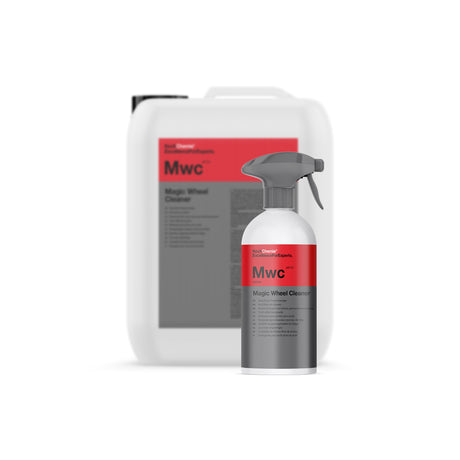
A fourth, often overlooked point: the wheels need their own treatment before the reactivation wash. Brake dust on the wheels contains iron and doesn't dissolve in the Rs rinse cycle. Anyone washing wheels together with the bodywork drags iron particles across the paint. First Magic Wheel Cleaner Mwc on the wheels, rinse, then the bodywork with the Rs. That's a pro sequence, not a detail tip.
What comes after the reactivation, maintenance instead of new coating
After the first Rs wash in May, the second water-droplet test follows. You spray the same hood again and watch how the water reacts. With an originally intact coating you now see clearly smaller, denser drops rolling off the surface at a high contact angle. The hydrophobic effect is back, often at 80 to 90 percent of its original level. What you now need is a plan for the coming weeks.
A second Rs application two to three weeks later locks in the result. Mineral deposits build up continuously, especially in pollen season and after every rain with limescale-rich precipitation. If you plan two to three reactivation washes in May, by June you'll have a paint that reacts the way it did shortly after the original coating application. The effort per wash stays manageable at 30 to 40 minutes.
Between the reactivation washes, a care shampoo like the Ces can make sense if the car is heavily used. High-mileage drivers with underground parking and commuters in pollen regions benefit, because the Ces builds a light protective film between washes that delays the next mineral deposit. But anyone alternating between Rs and Ces with every wash throws the system off balance. Rule of thumb: first run two Rs applications back-to-back, then switch to Ces maintenance.
When does a new coating make sense instead of a reactivation? When the water-droplet test still shows a flat film after two Rs applications, the SiO₂ bond is actually exhausted. This typically happens after 18 to 24 months, depending on weather exposure. Then the Rs is no longer enough, then it's time for a full reconditioning with polish and a fresh sealant. But in 70 percent of May cases in which buyers ask in the shop about a new coating, the coating isn't dead. There's just May sitting on the May paint.
The long-term sequence looks like this: two Rs applications in May for reactivation, then four to six weeks of maintenance with Ces or a classic pH-neutral shampoo. In late summer a single Rs repeat is enough to compensate for the summer UV load. In October, before winter starts, one final reactivation is worth it because the SiO₂ layer survives a winter with road salt and brine lake much better than a calcified, blocked sealant film. Translation for you: three to four Rs applications a year often replace the second full reconditioning.

Detailing1 insight: The honest water test works in three stages, not binary. Spray the hood, the roof, and the tailgate one by one. If only one of the three surfaces shows a flat film, you have a local limescale deposit and only need to reactivate one section. If all three show a flat film, full-surface reactivation is due. If all three still show a flat film after the Rs wash, then it really is time for a new coating. We see this in advice almost daily — customers save themselves a full reconditioning because the three-stage test shows the real situation.
No time for the whole post? Get it summarized: